
The 3ZHKUK/O class (specialising in ceramic and product design) of the HTBLVA Ortweinschule Graz and their art teacher Mag.a Agnes C. Katschner take part in three kunstGarten workshops focussed on the Mulberry starting in April. Funded by OEAD.
Part 1. The scientist Dr. Anna Gasperl gives insights into the history of European mulberry and silk production up to the present.
Working groups are formed to explore historical, ecological, economic, botanical, and artistic phenomena. Each group creates and presents a poster on their topic. For example: From Caterpillar to Silk, From Mulberry Leaf to Mulberry Paper, or Silk Textile Craft: Then and Now — traditional silk farming (spinning cocoons and harvesting after eight days) and innovative methods (spinning on flat surfaces or shapes as practiced by Sericyne, France https://www.youtube.com/watch?v=GJKuI8u4FxA). Topics may also include design with or on silk, socio-economic perspectives for women, and the ecological importance of mulberry trees for microclimate, biodiversity, and soil health.
Part 2. Irmi Horn conveys a literary approach with Ovid’s Metamorphoses and expands the tragic love story of Pyramus and Thisbe through the encounter with Shakespeare’s Romeo and Juliet.
Part 3. The students create pencil drawings, present them, and discuss what emotions or impressions the works evoke in the class — for example, joy expressed through body posture. Later, under the guidance of Mag. Katschner, the students will create ink drawings on mulberry paper at school. These works will be presented in a public exhibition at the kunstGarten in Part 4, on May, 22. During the exhibition, the students will talk about their creative process and explain their interpretations.
Dr. Anna Gasperl is responsible for the project NATURVERBUNDEN. The southeastern Styria, also known as the Styrian Volcanic Land, is much more than a pretty postcard motif. With nine nature reserves, the Lower Murtal Biosphere Park and a variety of innovative projects, the region proves how to reconcile sustainability and progress. Here, nature conservation is not so incidental – it becomes a master plan for the future. Dr. Anna Gasperl conducts research under the direction of Ao.Prof. Dr. Andreja Urbanek Krajnc, Chair of Botany and Plant Physiology at the Faculty of Agriculture and Natural Sciences of the University of Maribor, Slovenia. As part of the interdisciplinary EU Horizon project “ARACNE Advocating the role of Silk Art and Cultural Heritage at National and European Scale”, she works with European colleagues to investigate the geographical distribution and genetic and ingredient diversity of mulberry trees and their use in mixed crops and renaturalization.
She also works committed to planting mulberries.
From myth to modernity: Mulberry trees in Europe
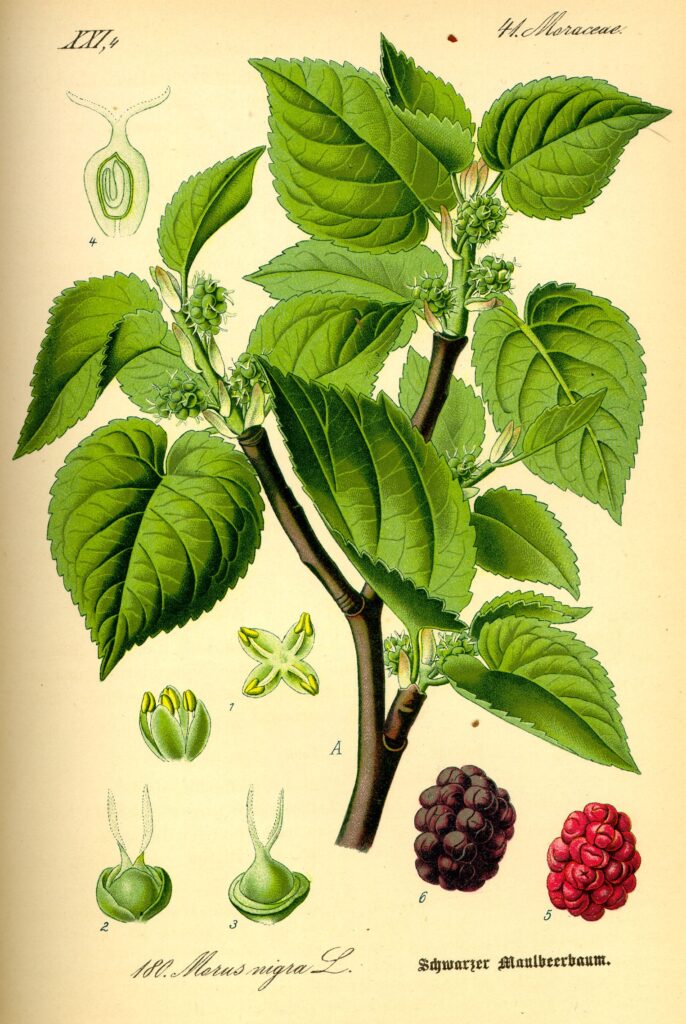
Even in the times of Ovid, who described the tragic fate of the lovers Pyramus and Thisbe, mulberry trees were widespread in southern Europe. As the only food source for the larvae of the real silk spider, mulberry leaves were highly valued for centuries. For a long time, silk was an exclusive and expensive rarity, which was primarily reserved for the clergy and the nobility. In her lecture, Dr. Anna Gasperl gives fascinating insights into the history of European mulberry and silk production up to the present. It shows how a sustainable future can be shaped through innovative agro-ecological and technological approaches. Mulberries are not only suitable as climate-friendly shade providers, they also make an important contribution to the renaturalization of soils contaminated with heavy metals.