
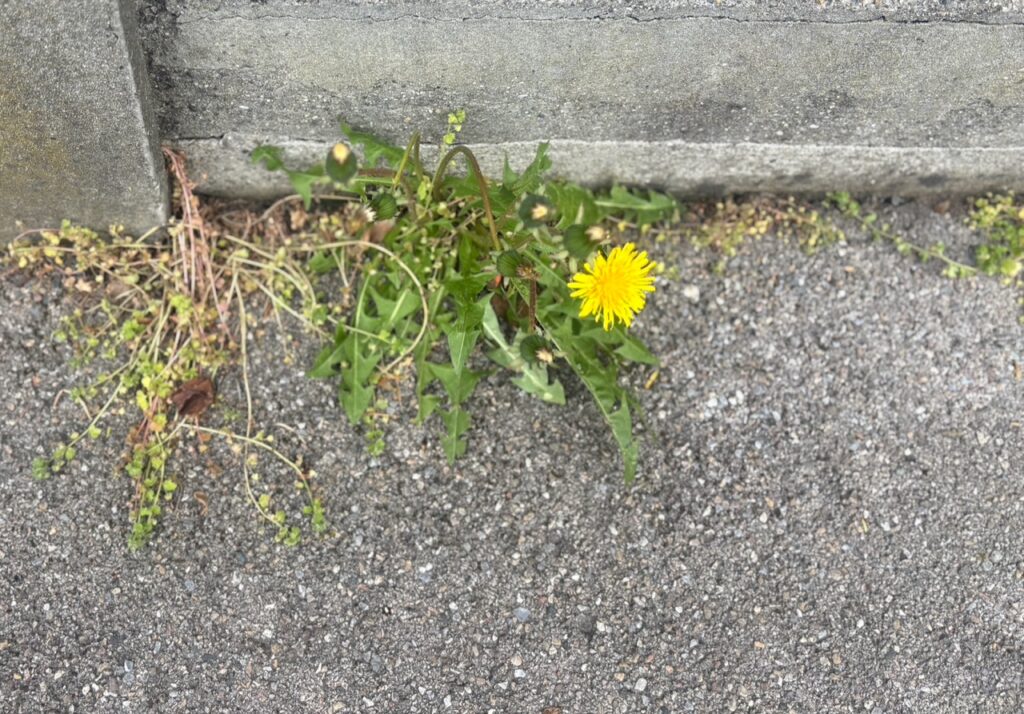
Löwenzahn (Taraxacum). Photo kunstGarten
Alexandra Gschiel & Markus Wilfling.
Curated by Irmi Horn.
Welcome: Dr.in Claudia Unger.
Opening Speaker: Christina Töpfer (Editor-in-chief), Camera Austria
Curator’s Reflections:
Although this part of the city is characterized by generous green spaces, it is equally shaped by residential blocks, repetitive urban structures, and environments that can appear emotionally detached. Within such settings, even the smallest intervention—a flower, a plant, an unexpected gesture—can alter the perception of an entire place.
As BLOOM activates Graz through Kunsthaus Graz, kunstGarten responds with a living plant archive and newly commissioned works by the participating artists. Their interventions explore the relationship between cultivated and constructed environments, allowing the artificial to enter into dialogue with the botanical—whether through harmony, friction, or quiet coexistence.
The exhibition reflects on the transformative potential of singular presences. A flowering plant on a grey façade, a wild blossom emerging from intensively cultivated land, or an overlooked species thriving at the roadside can become acts of quiet resistance that reveal both ecological fragility and unexpected resilience. Yet these moments also raise questions about perception itself: what do we still notice, and what has disappeared from our field of attention?
Beyond the botanical, the works extend this reflection to human relationships. Within landscapes of routine, indifference, or visual excess, a single gesture of generosity, one remarkable artwork, or one fleeting encounter may become disproportionately meaningful. Such moments remind us that significance often resides not in abundance but in singularity.
The exhibition ultimately proposes plants as more than decorative elements or ecological indicators. They become metaphors for presence, care, and coexistence, inviting us to reconsider our awareness of the environments we inhabit and of those—human and more-than-human—with whom we share them. Every presence has the capacity to transform its surroundings. The question is not only what we see, but whether we still allow ourselves to be affected.
Alexandra Gschiel approaches these questions through the medium of the pinhole camera. In a visual language that recalls the aesthetics of lomography, she brings fleeting yet significant moments into focus. Deliberately embracing technical imperfections, her photographs evoke impressions that leave space for imagination, while their subtle distortions become vehicles through which perception itself is reflected upon.
What appears to be a spontaneous snapshot is, in fact, the result of prolonged stillness—of immersing oneself in a state of concentrated attention that might even be described as meditative. The resulting images do not simply record the world; rather, they reveal the very act of seeing, making visible how perception itself unfolds.
What appears to be a spontaneous snapshot is, in fact, the result of prolonged stillness—of immersing oneself in a state of concentrated attention that might even be described as meditative. The resulting images do not simply record the world; rather, they reveal the very act of seeing, making visible how perception itself unfolds.
Markus Wilfling turns his attention to the remains of a tree. By intervening in its trunk, he enters into a dialogue with an organically grown structure, making visible both the creative potential and the hubris inherent in human action.
The work points to our dependence on nature—the very ground in which our existence is rooted. It invites reflection on the fragile balance between use and exploitation, between care and abuse, between appropriation and responsibility.
At the same time, the tree trunk becomes the sculpture of something once alive. Subject to weather and time, its surface continues to change, allowing the work to remain in a state of transformation. It evokes an awareness of impermanence while affirming the quiet beauty of existence itself.
Against this backdrop, the persistent pursuit of ever more—driven by individual interests, collective ambitions, or political power—appears increasingly self-destructive. The unwillingness to question this logic recalls a tragic act of folly: one that undermines the very foundations on which human life depends.
P.S.:
kunstGarten had originally invited the Norwegian artist couple Andrea Bakketun and Christian Tony Norum as artists-in-residence, continuing its commitment to bringing international contemporary art to Graz’s 5th district.
As the two artists did not receive funding for 2026, the programme was postponed and exchanged with the Austrian artists originally planned for 2027. Alexandra Gschiel and Markus Wilfling, both internationally active in their own right, are now realizing this year’s newly commissioned interventions for kunstGarten.