
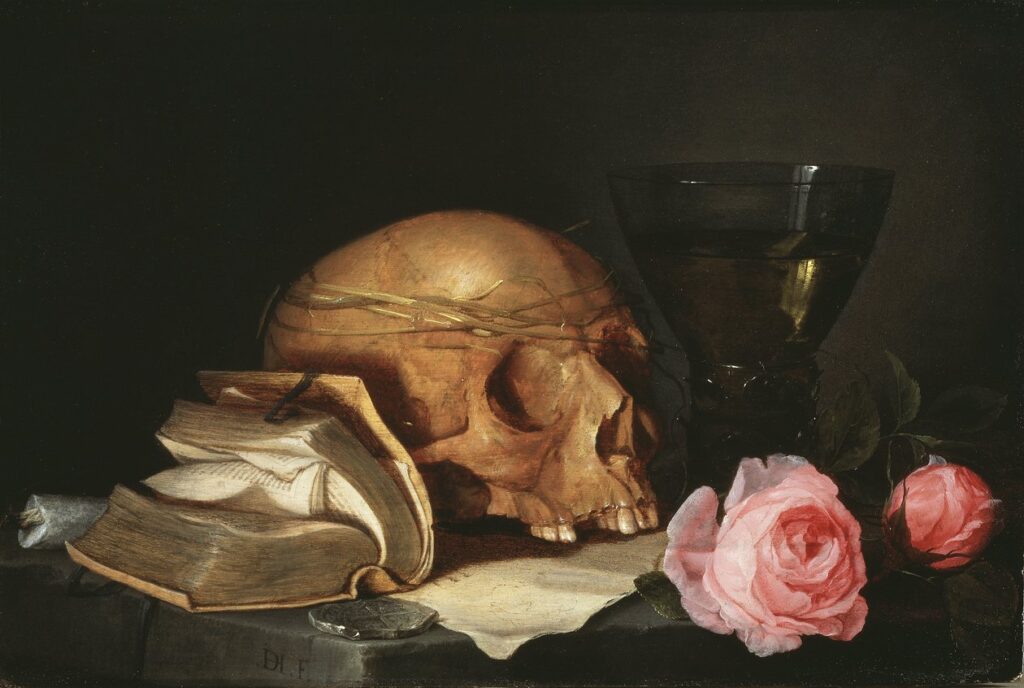
Jan Davidsz de Heem (* April 1606 in Utrecht; † 1683 oder/or 1684 in Antwerpen)
Seduction & Resistance.
Mary-Audrey Ramirez LUX (artist in residence)
Thomas Hitchcock A
Curator: Irmi Horn
Mary-Audrey Ramirez (*1990 in Luxembourg, lives in Berlin) studied under Thomas Zipp at the University of the Arts in Berlin from 2010 to 2016.
She has received multiple awards and artist residencies including at ISCP New York City, USA in 2022, in 2019 she was the recipient of the prestigious Edward Steichen Award in Luxembourg for her textile-based sculptural and pictorial works.
Her works have been shown at Esch2022 + ARS ELECTRONICA (Luxembourg/Linz), Overbeck Gesellschaft (Lübeck), Dortmunder Kunstverein (Dortmund), Kunstmuseum Heidenheim, Kunsthalle Erfurt and Max Ernst Museum (Brühl).
2023 saw a solo exhibition by Mary-Audrey Ramirez at Kunsthalle Gießen, furthermore works by her were shown in the exhibitions HIGH FIVE (Kunstpalais Erlangen), TOD UND TEUFEL (Kunstpalast Düsseldorf) and in YOUR HOME IS WHERE YOU’RE HAPPY (Haus Mödrath, Kerpen).
In 2024, Ramirez opened her solo exhibition at Casino Luxembourg followed by her exhibitions UNSOLICITIED AWAKENING at Kai 10 in Düsseldorf and COMPANIONS at MARTINETZ in Cologne.
Thomas Hitchcock
is a visual artist, he lives and works in Vienna and Belgium, although so far also longer work stays took him to Lisbon and Berlin. He creates sculptural and pictorial objects, examines and illuminates various social, political and aesthetic phenomena.
Thomas Hitchcock, born in Bruck/Mur (AT) in 1989, graduated from the University of Applied Arts Vienna in 2017 with Brigitte Kowanz. He also studied at ENSAPC in Paris and was part of the Independent Study Programme Maumaus in Lisbon in 2020. Some projects took place in 2020 in an interdisciplinary group exhibition format curated by him with the publication of the same name intermezzo in Lisbon and have been accessible since 2018 as art in public space in the redesign of Peter-Alexander-Platz unscene in Vienna-Grinzing. Some of his objects have already been purchased by the state of Styria and the collection of the University of Applied Arts Vienna.
Most recently, his works were shown at the “Förderungspreis des Landes Steiermark für zeitgenössische Kunst” in the Neue Galerie in Graz from 28.11.2025 – 06.04.2026 and from January to March 2026 the project “Abstract Entities” at the KIOSK in Ghent.
In the kunstGarten he presents wall works with the subject Punica granatum, a combination of media sculpture, photography and drawing.
The pomegranate has diverse cultural-religious meaning, is a symbol for life and fertility because of the many seeds, but also for power (King’s apple), blood and death. Already in Greek and Persian mythology we find the pomegranate as a symbol of fertility, beauty and eternal life.
The pomegranate is one of the most permanent and at the same time the most ambiguous pictorial motifs in the history of art. Since ancient times, it has functioned as a symbolic bearer of fertility, abundance and renewal, but at the same time as a sign of limitation, protection and resistance. In his iconographic ambivalence, he combines sensual seduction with the necessity of restraint.
Its bright color and the multitude of cores evoke fullness, desire and vitality, while the hard, closed shell withdraws the interior from immediate access. This formal tension makes the pomegranate a visual model for the relationship between external attraction and inner unavailability. Seduction does not appear here as free enjoyment, but as a controlled, symbolically regulated act.
In ancient Egyptian art, the pomegranate stands in the context of funerary practices for the resistance of life against death and for the hope of rebirth. This meaning is transformed and theologically charged in the Christian iconography of the Renaissance. In works by Fra Angelico or Sandro Botticelli, the pomegranate appears as an attribute of Madonna and Christ Child and at the same time refers to resurrection, redemption and the unity of the faithful. Its closed form functions as a sign of chastity and intellectual discipline, while the cores hidden inside symbolize the promised salvation.
The pomegranate marks a threshold in these representations: between this world and the afterlife, physicality and transcendence, desire and moral resistance. This double meaning also remains effective in the heraldic and political imagery – for example in the Spanish coat of arms or as an emblem of the city of Granada. The pomegranate stands here for duration, identity and cultural perseverance as well as for expansion and promise of wealth.
In the summary, the pomegranate reveals itself as a motif that does not put seduction and resistance as opposites, but as mutually conditioning forces in the picture. Its iconographic stability is based precisely on this tension, which positions the viewer between attraction and distance and makes the pomegranate a paradigmatic symbol of the life cycle.
Duration of the exhibition: until 12. July
Seduction and Resistance – Strategies of Survival
Seduction is not limited to sensual or culinary pleasures. It works on a deeper level: it can shake our convictions, weaken our will, and guide our actions. Human beings have always striven for more—for knowledge, meaning, and orientation. Rarely are they content with what already exists.
Where needs remain unfulfilled, however, susceptibility to seduction grows. In such moments, simple answers appear attractive, alternative interpretations plausible, political promises alluring. Art has repeatedly taken up and made visible this dynamic over the centuries.
Already in Christian iconography, the Fall of Man stands for the consequential power of seduction: the promise of knowledge leads to the loss of innocence. In ancient mythology, the Sirens embody that seductive voice which robs one of orientation and leads to ruin.
In Early Modern art, seduction often appears in an ambivalent guise: figures such as Judith use beauty and proximity as means to overcome violence and oppression. Seduction here becomes a conscious strategy—morally complex and staged with tension.
With modernity, the political dimension increasingly comes into focus. Artists such as Francisco de Goya expose in their prints humanity’s susceptibility to superstition, power, and fear. In the twentieth century, works of political art—such as John Heartfield’s photomontages—make visible how ideology, propaganda, and simple images can seduce and manipulate the masses.
Opposed to seduction is resistance. This, too, is a recurring motif in art: as an act of conscience, as doubt, as open defiance. Resistance can express itself quietly or loudly, individually or collectively, symbolically or concretely.
To understand the temptations of our present and the necessity of resistance, a look into history—and into its images—is indispensable.
For centuries, the rose has been regarded as a symbol of seduction. Its color, form, and fragrance appeal to the senses and attract. At the same time, it sets boundaries: thorns protect it from being eaten and from careless grasping. Within it, a fundamental principle is condensed that extends far beyond the rose itself.
Plants are not passive beings. They possess highly developed strategies of survival based on attraction and defense. Colors, scents, nectar, or forms serve seduction—they lure pollinators and ensure reproduction and dispersal. At the same time, plants develop protective mechanisms: thorns, poisons, bitter substances, or hard surfaces deny access and defend life itself.
This dual strategy—seduction and refusal—has always found resonance in art. Flower still lifes, botanical studies, and symbolically charged representations show plants not merely as decorative motifs, but as actors in a finely balanced interplay between attraction and resistance. The rose thus becomes a pars pro toto: an image of a nature that both invites and withdraws.
Women artists have depicted these tensions with particular sensitivity.
Artemisia Gentileschi shows in her paintings women who act with self-determination, strength, and often resistance—such as Judith overpowering Holofernes, or Susanna defending herself in Susanna and the Elders.
Rachel Ruysch, a master of Baroque flower still lifes, stages plants in their beauty and vulnerability, with fine details of blossoms and thorns that simultaneously entice and repel. In contemporary art, Olafur Eliasson investigates the relationship between nature, perception, and experiences of boundaries, while Kara Walker symbolically plays with motifs of beauty and threat. She confronts her viewers with images that attract and at the same time repel—similar to a familiar motif that, upon closer inspection, loses its beauty and produces unease. In this sense, she exposes the seduction of seemingly harmless narratives and lays bare the underlying power structures.
Jennifer Wen Ma (born 1973 in Beijing, lives and works between New York and Beijing) uses plants as both material and metaphor. She is particularly known for works in which she covers living plants with Chinese ink—an organic, plant-based medium—thus transforming them into living sculptures and interactive landscapes. In her installation Hanging Garden in Ink (2012), around 1,500 living plants were dyed black with Chinese ink and suspended in the exhibition space. The work plays with the contrast between life and stasis: the plants continue to grow, producing green buds that emerge from the black ink, thereby making visible the resilience and endurance of life.
Plants initially become visible through their form, color, and presence and draw attention to themselves—especially as they create a kind of garden image within the space that feels natural, familiar, and sensual. Despite being slowed by the ink, the plants continue to grow and break forth anew. This visible—almost combative—growth can be read as a metaphor for the will to survive, persistence, and the resilience of life.
In a broader sense, these botanical strategies also reflect human experiences. Seduction and resistance, desire and boundary, proximity and distance are not solely cultural or political phenomena—they are deeply rooted in the mechanisms of life itself.
Viewing plants thus opens up a new perspective: seduction no longer appears merely as a moral temptation, but as an elemental force of survival. Resistance, in turn, becomes a necessary condition of self-assertion. Together, the two form a balance that connects nature, art, and society.