
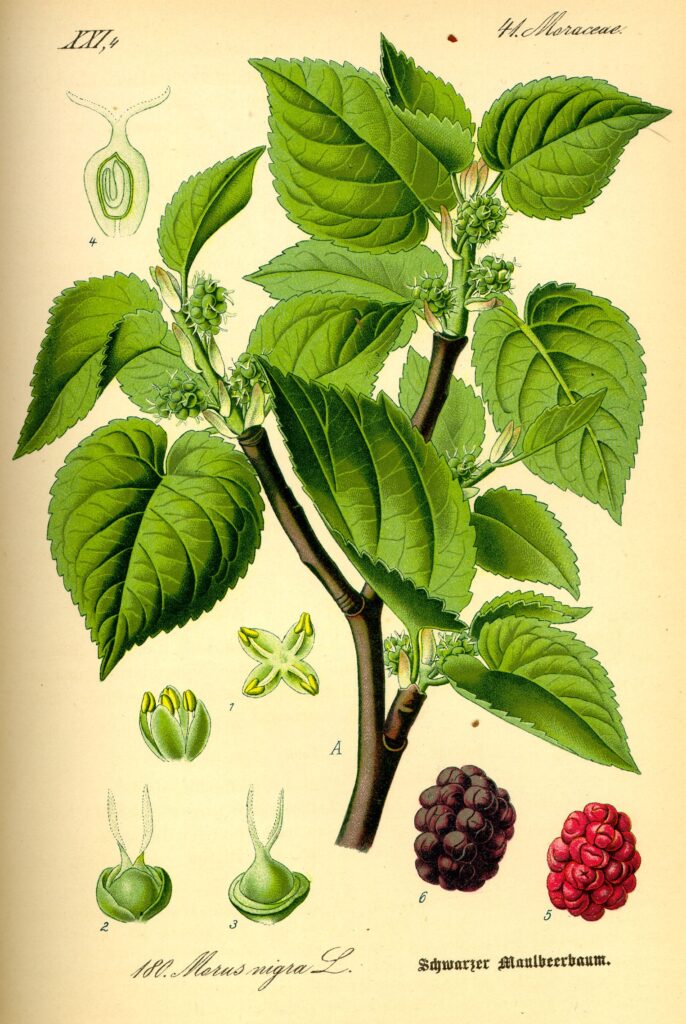
The class 3ZHKUK/O (specializations ceramic design, product design) of the HTBLVA Ortweinschule Graz and their art teacher Mag.a Agnes C. Katschner take part in three art garden workshops on mulberry starting in April. Funded by OEAD.
The scientist Dr. Anna Gasperl gives insights into the history of European mulberry and silk production up to the present.
Irmi Horn conveys a literary approach with Ovid’s Metamorphoses and expands the tragic love story of Pyramus and Thisbe through the encounter with Shakespeare’s Romeo and Juliet.
Inch drawings are created at school under the direction of Mag.a Katschner on mulberry paper, which in the 3rd Workshop (probably at the end of June) in the kunstGarten in a public exhibition. The students report on their access and explain their interpretation.
Dr. Anna Gasperl is responsible for the project NATURVERBUNDEN. The southeastern Styria, also known as the Styrian Volcanic Land, is much more than a pretty postcard motif. With nine nature reserves, the Lower Murtal Biosphere Park and a variety of innovative projects, the region proves how to reconcile sustainability and progress. Here, nature conservation is not so incidental – it becomes a master plan for the future.
She also works committed to planting mulberries:
From myth to modernity: Mulberry trees in Europe
Even in the times of Ovid, who described the tragic fate of the lovers Pyramus and Thisbe, mulberry trees were widespread in southern Europe. As the only food source for the larvae of the real silk spider, mulberry leaves were highly valued for centuries. For a long time, silk was an exclusive and expensive rarity, which was primarily reserved for the clergy and the nobility. In her lecture, Dr. Anna Gasperl gives fascinating insights into the history of European mulberry and silk production up to the present. It shows how a sustainable future can be shaped through innovative agro-ecological and technological approaches. Mulberries are not only suitable as climate-friendly shade providers, they also make an important contribution to the renaturalization of soils contaminated with heavy metals.
Dr. Anna Gasperl conducts research under the direction of Ao.Prof. Dr. Andreja Urbanek Krajnc, Chair of Botany and Plant Physiology at the Faculty of Agriculture and Natural Sciences of the University of Maribor, Slovenia. As part of the interdisciplinary EU Horizon project “ARACNE Advocating the role of Silk Art and Cultural Heritage at National and European Scale”, she works with European colleagues to investigate the geographical distribution and genetic and ingredient diversity of mulberry trees and their use in mixed crops and renaturalization.