
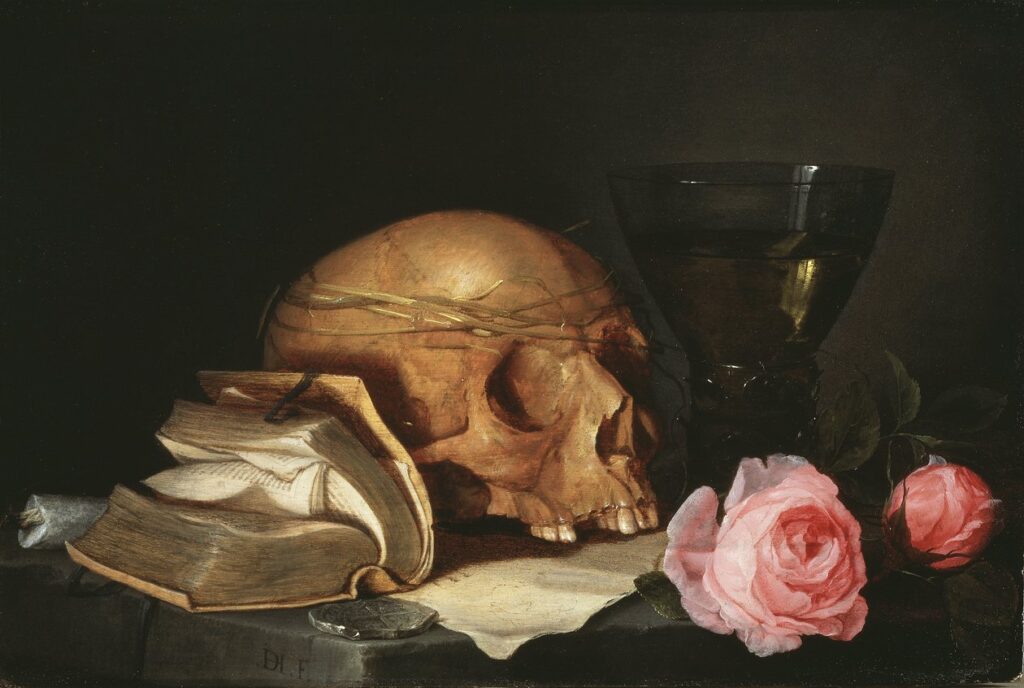
Jan Davidsz de Heem (* April 1606 in Utrecht; † 1683 oder/or 1684 in Antwerpen)
Seduction and Resistance – Strategies of Survival
Exhibition is open to the public until July, 12.
Fatma Abdulhadi (SAU), Mary-Audrey Ramirez (LUX) and Thomas Hitchcock (A) present their perspectives on and connections to the theme to the audience. (SAU)
Curated by: Irmi Horn
Welcome: Town Councillor Dr.in Claudia Unger.
Opening Speaker: Tanja Gurke
Curator’s Introduction
Fatma Abdulhadi (*1988 in Riyadh, Saudia Arabia)
Fatma is a multidisciplinary artist working across drawing, printmaking, and material research. Since 2011, she has contributed to the contemporary art scene in Saudi Arabia, establishing herself as both an artist and educator. She currently leads the silkscreen studio at Misk Art Institute, alongside her independent studio in Riyadh.
Abdulhadi’s work focuses on the relationship between memory, nature, and human experience. She develops her own pigments and inks from plant-based and organic materials, incorporating them into layered silkscreen prints and installations. Her practice often involves working with transparent surfaces such as mesh, creating compositions that explore light, depth, and the passage of time.
She has led numerous workshops and educational programs and has exhibited her work in Saudi Arabia and internationally.
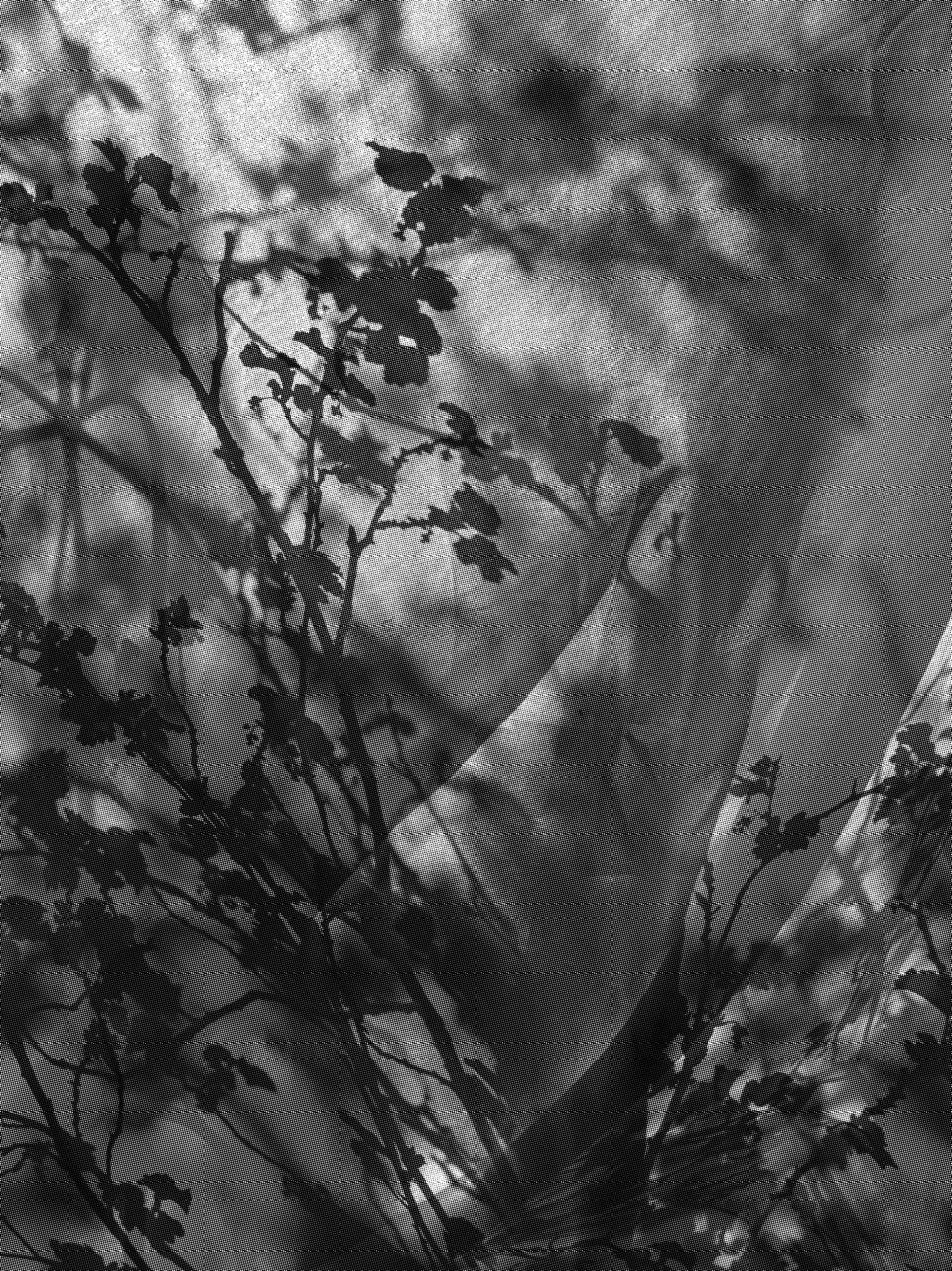
Fatma Abdulhadi, THE SKIN OF THE GARDEN, 2026, Videostill
Fatma Abdulhadi will present an installation “The Memory of the Soul” developed from her recordings and the pressure: the plants appear like figures in a shadow play, allowing us to enter into a relationship with the “other” world behind a veil. When the installation is moved by the wind, it reveals itself to us as a performance. Whether it strikes us as obscene or heroic, tragic or elegiac, dramatic or calming is left to the viewers to decide. These differing interpretations also reveal how easily our perception can be shaped and how the shadows allow for a rich unfolding of imagination.
In the realm of art, this primarily fosters the positive expansion of imaginative capacity. In the context of social coexistence and research, however, fabricated perceptions can lead to cruel and destructive consequences. As captivating as the shadow play may be, holding us in its spell, a veil still prevents a direct, unmediated view of primary existence.
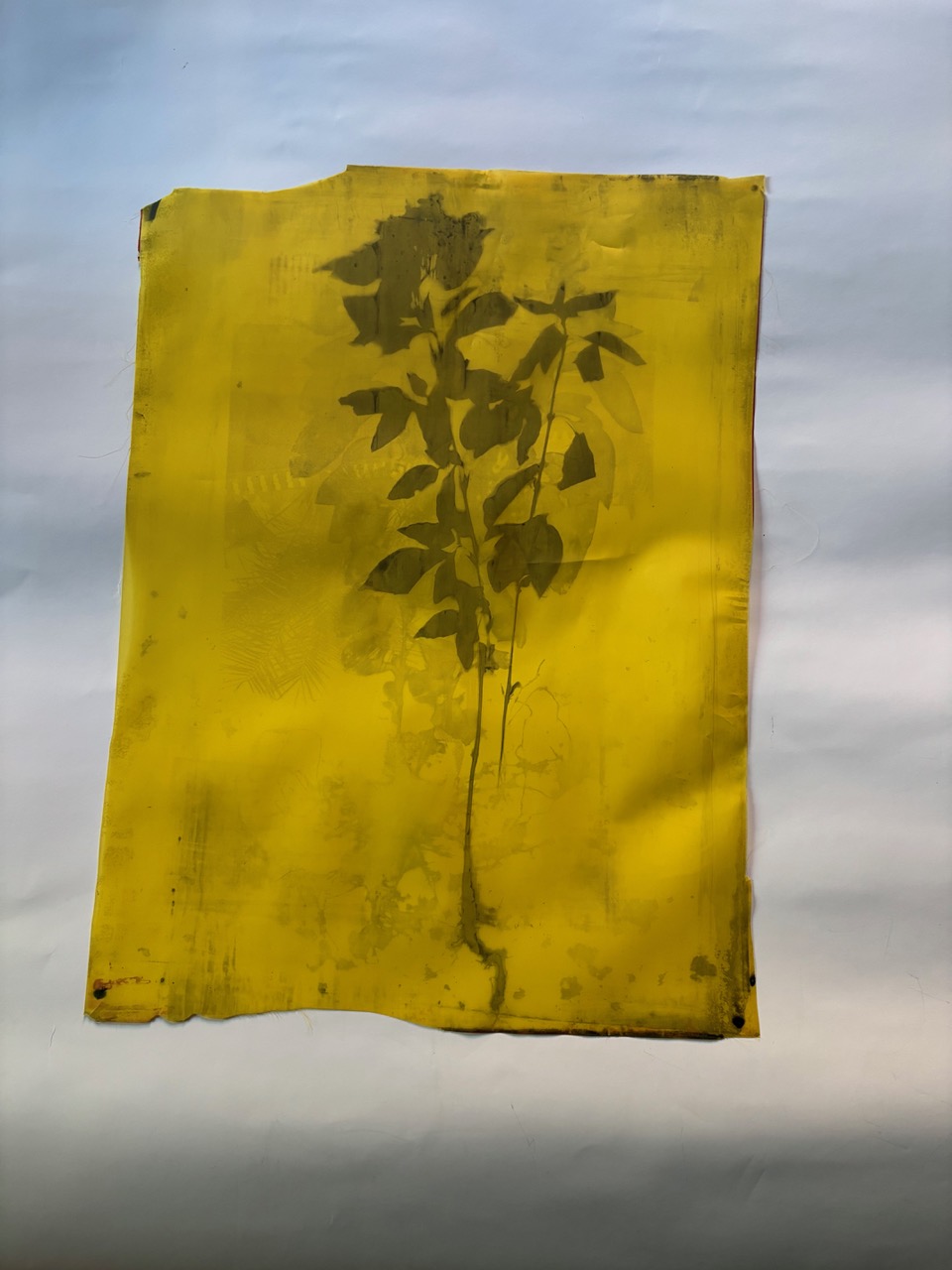
Fatma Abdulhadi, „The Memory of the Soul“, multi-layer print 2023
Created in 2023, this work “The Memory of the Soul” emerged through multiple layers of printing, image removal, and repeated reworking of the surface. Through the process, ghost images began to appear within the prints traces that remained as attempts to hold onto memory, recycle it, and allow it to transform over time. The work became a skin-like sketchbook, carrying the early gestures and fragments that later evolved into the beginning of all the gardens.
Ghost prints remain within the mesh through repetition, washing, pressure, and time. What fades never fully disappears; instead, it settles into the material as memory. Within Fatma Abdulhadi’s practice, basil appears as both a healing symbol and a personal archive of remembrance. Growing up, the scent of basil was tied to prayer, comfort, and the memory of loved ones — carrying a spiritual and emotional presence that continues to shape her relationship with nature, loss, and healing. In the work, the basil becomes a quiet portrait of absent souls.
Layers of print hold traces of touch, grief, and survival. Repetition within the silkscreen process becomes an act of remembrance, where each impression leaves behind a residue that cannot be fully erased. Like memory itself, the material absorbs pressure, time, and transformation.
Fragile yet persistent, the basil branch exists between disappearance and endurance. Through printmaking, erasure is never complete; memories continue to shift, settle, and take new forms over time.
Excerpts from the article on Arabic shadow theatre: There is broad agreement that shadow theatre originated in Asia. It engages with the interplay between reality and a world beyond. For an audience deeply immersed in the shadow play, the shadow itself appears as the true actor in its own realm, while the figure casting it becomes secondary.
Az-zill (“shadow”) in contrast to an-nūr (“light”) forms a frequently encountered pair of opposites in Islamic metaphysics: the derived versus the primary existence. According to Ibn Arabi, this world (ad-dunyā) is the shadow of the Absolute. The Egyptian Sufi poet Ibn al-Fārid (1181–1235), who recognized shadow theatre as a metaphor for the illusory nature of human existence, explains its symbolic meaning in his mystical poem Nazm as-sulūk (“The Order of the Path”): the shadow figures represent the sensory organs, the screen symbolizes the human body, and the puppeteer signifies the divine soul. Ibn al-Fārid also provides the earliest known description of the content of Arabic shadow theatre. The scenes included heavily armed armies fighting on land and at sea, supernatural beings, wild lions, and simple fishermen. The figures depicted both heroic tales and everyday life, evoking powerful emotions in the audience.
Mary-Audrey Ramirez (*1990 in Luxembourg, lives in Berlin) studied under Thomas Zipp at the University of the Arts in Berlin from 2010 to 2016.
She has received multiple awards and artist residencies including at ISCP New York City, USA in 2022, in 2019 she was the recipient of the prestigious Edward Steichen Award in Luxembourg for her textile-based sculptural and pictorial works.
Her works have been shown at Esch2022 + ARS ELECTRONICA (Luxembourg/Linz), Overbeck Gesellschaft (Lübeck), Dortmunder Kunstverein (Dortmund), Kunstmuseum Heidenheim, Kunsthalle Erfurt and Max Ernst Museum (Brühl).
2023 saw a solo exhibition by Mary-Audrey Ramirez at Kunsthalle Gießen, furthermore works by her were shown in the exhibitions HIGH FIVE (Kunstpalais Erlangen), TOD UND TEUFEL (Kunstpalast Düsseldorf) and in YOUR HOME IS WHERE YOU’RE HAPPY (Haus Mödrath, Kerpen).
In 2024, Ramirez opened her solo exhibition at Casino Luxembourg followed by her exhibitions UNSOLICITIED AWAKENING at Kai 10 in Düsseldorf and COMPANIONS at MARTINETZ in Cologne.
In her work she develops an installation: Alien Insects on Alien Plants and thus refers to the fragileness of flora and fauna when breaking through the “natural” cycles on the one hand, on the other hand she explains modern and futuristic approaches to the resilience of humanity in matters of giving and taking, which is probably based on a kind of hubris, and thus shows the seduction of the cyber world.
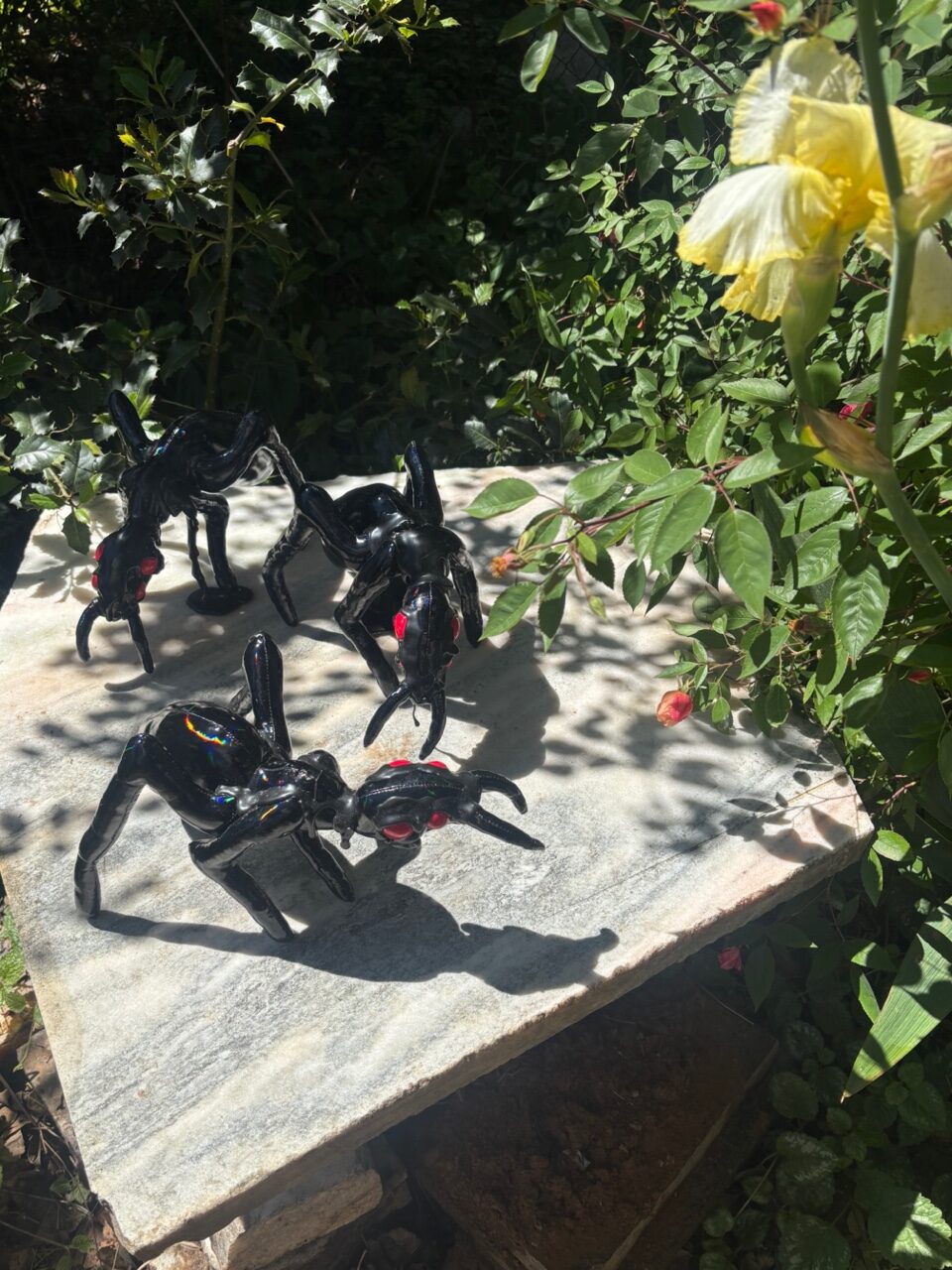
Mary Audrey Ramirez, Alien Insects, 2026, Vinyl, PVC, Metall
Thomas Hitchcock is a visual artist based in Vienna and Belgium, although he has had longer work stays in Lisbon and Berlin. He creates sculptural and pictorial objects, examines and illuminates various social, political and aesthetic phenomena.
Thomas Hitchcock, born in Bruck/Mur (AT) in 1989, graduated from the University of Applied Arts Vienna in 2017 with Brigitte Kowanz. He also studied at ENSAPC in Paris and was part of the Independent Study Programme Maumaus in Lisbon in 2020. Some projects took place in 2020 in an interdisciplinary group exhibition format curated by him with the publication of the same name intermezzo in Lisbon and have been accessible since 2018 as art in public space in the redesign of Peter-Alexander-Platz unscene in Vienna-Grinzing. Some of his objects have already been purchased by the state of Styria and the collection of the University of Applied Arts Vienna.
Most recently, his works were shown at the “Förderungspreis des Landes Steiermark für zeitgenössische Kunst” in the Neue Galerie in Graz from 28.11.2025 – 06.04.2026 and from January to March 2026 the project “Abstract Entities” at the KIOSK in Ghent.
He presents wall works with the subject Bellies in the art garden: Punica granatum serves as a plant template. The works represent a combination of medium, sculpture, photography and drawing.
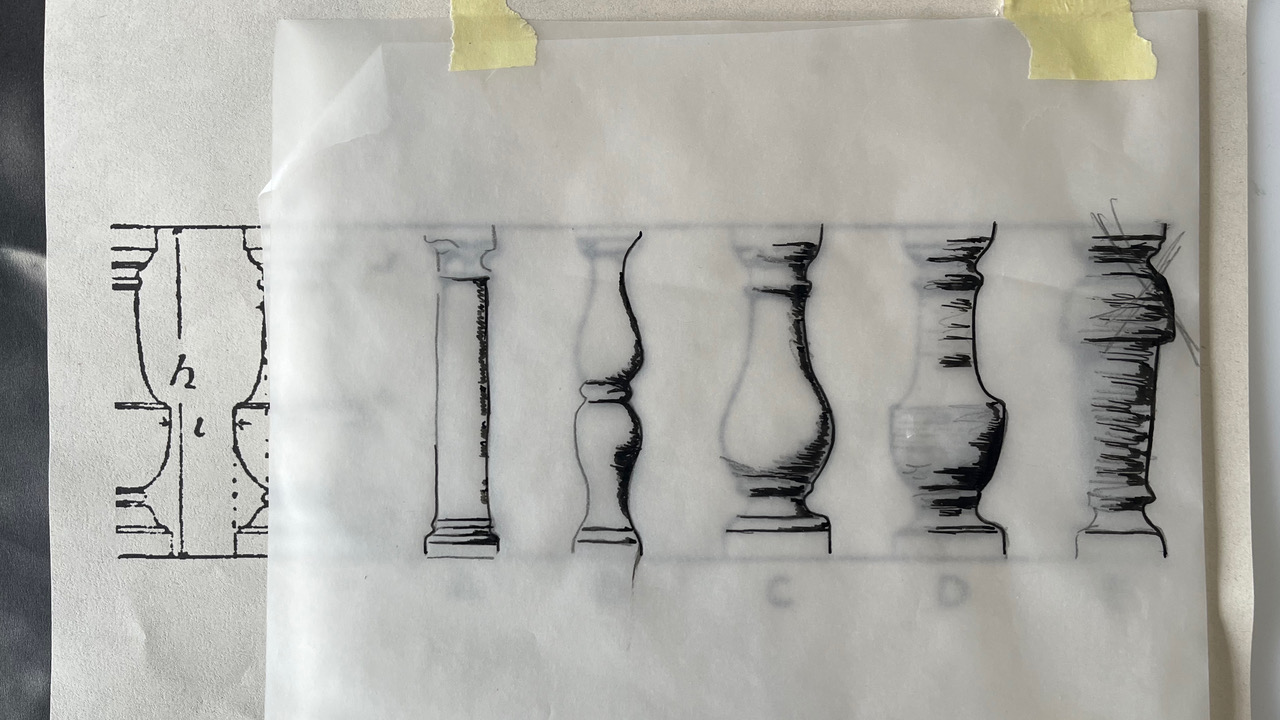
Thomas Hitchcock, Baluster (Bellies) 2025
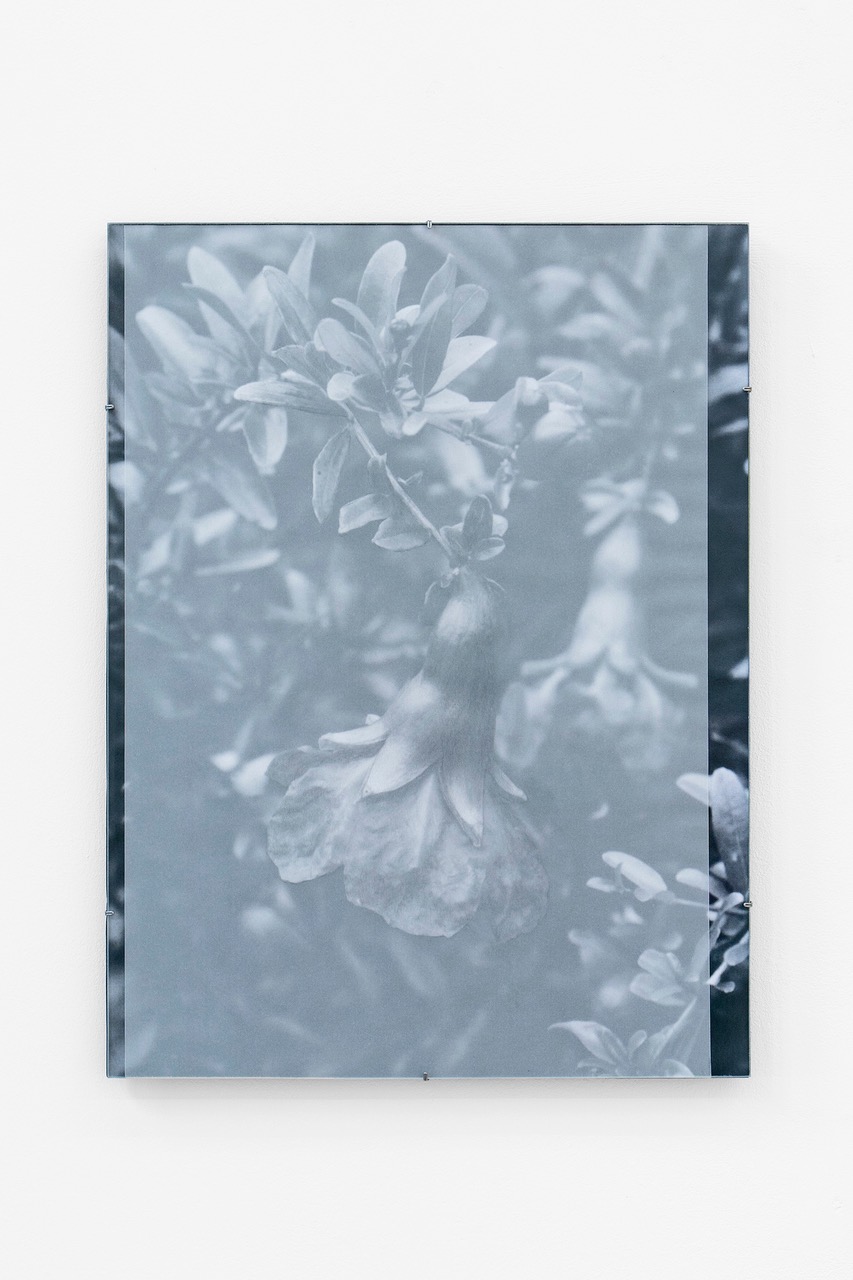
Thomas Hitchcock, Ohne Titel (Bellies), 2025 Bleistift auf Transparentpapier, Digitaldruck, gerahmt 40 × 30 × 2 cm
Starting from the architectural element of the baluster and its etymological origin in the flower of the pomegranate tree, it establishes a connection between this delicate, sensual flower and the element of the baluster, which acts more as a barrier or boundary.
The black and white photos are partially covered with a sheet of tracing paper and the motif of the flower is partly painted over with a pencil which gives the picture a sculptural effect. Through this superposition of several layers and their fusion, he addresses the threshold between different levels, the inside merges with the outside, the boundary is softened.
The term baluster comes from the French balustre, or the synonymous Italian balaustro and goes back to the ancient Greek βαλαύστριον / balaustion = flower of the wild pomegranate tree, unripe pomegranate.
The pomegranate has diverse cultural-religious meaning, is a symbol for life and fertility because of the many seeds, but also for power (King’s apple), blood and death. Already in Greek and Persian mythology we find the pomegranate as a symbol of fertility, beauty and eternal life.
The pomegranate is one of the most permanent and at the same time the most ambiguous pictorial motifs in the history of art. Since ancient times, it has functioned as a symbolic bearer of fertility, abundance and renewal, but at the same time as a sign of limitation, protection and resistance. In his iconographic ambivalence, he combines sensual seduction with the necessity of restraint.
Its bright color and the multitude of cores evoke fullness, desire and vitality, while the hard, closed shell withdraws the interior from immediate access. This formal tension makes the pomegranate a visual model for the relationship between external attraction and inner unavailability. Seduction does not appear here as free enjoyment, but as a controlled, symbolically regulated act.
In ancient Egyptian art, the pomegranate stands in the context of funerary practices for the resistance of life against death and for the hope of rebirth. This meaning is transformed and theologically charged in the Christian iconography of the Renaissance. In works by Fra Angelico or Sandro Botticelli, the pomegranate appears as an attribute of Madonna and Christ Child and at the same time refers to resurrection, redemption and the unity of the faithful. Its closed form functions as a sign of chastity and intellectual discipline, while the cores hidden inside symbolize the promised salvation.
The pomegranate marks a threshold in these representations: between this world and the afterlife, physicality and transcendence, desire and moral resistance. This double meaning also remains effective in the heraldic and political imagery – for example in the Spanish coat of arms or as an emblem of the city of Granada. The pomegranate stands here for duration, identity and cultural perseverance as well as for expansion and promise of wealth.
In the summary, the pomegranate reveals itself as a motif that does not put seduction and resistance as opposites, but as mutually conditioning forces in the picture. Its iconographic stability is based precisely on this tension, which positions the viewer between attraction and distance and makes the pomegranate a paradigmatic symbol of the life cycle.
In May, the Rose Season begins. Almost everyone knows the following song:
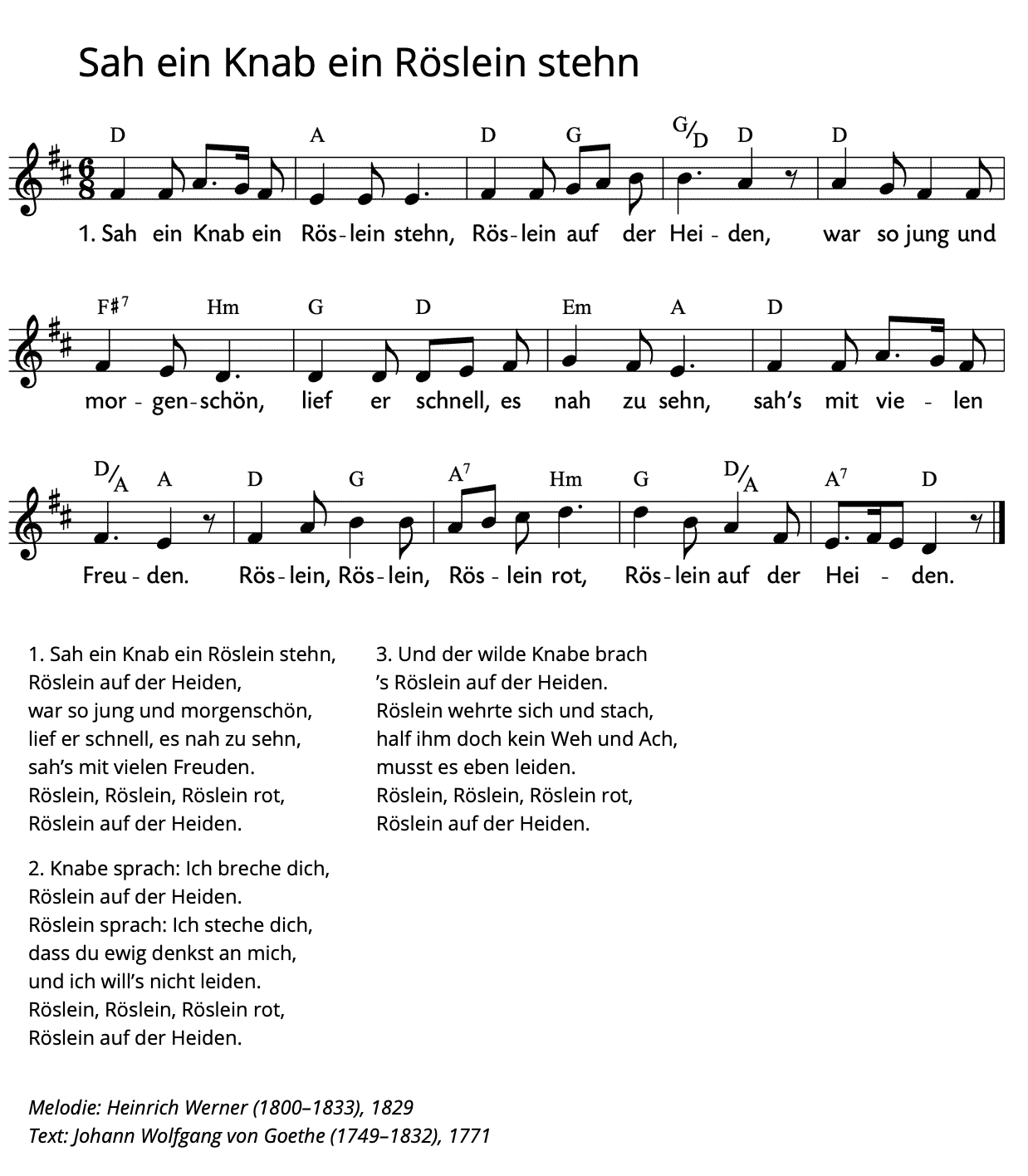
Sah ein Knab’ ein Röslein stehn
English translation © Richard Wigmore
A boy saw a wild rose
growing in the heather;
it was so young, and as lovely as the morning.
He ran swiftly to look more closely,
looked on it with great joy.
Wild rose, wild rose, wild rose red,
wild rose in the heather.
Said the boy: I shall pluck you,
wild rose in the heather!
Said the rose: I shall prick you
so that you will always remember me.
And I will not suffer it.
Wild rose, wild rose, wild rose red,
wild rose in the heather.
And the impetuous boy plucked
the wild rose from the heather;
the rose defended herself and pricked him,
but her cries of pain were to no avail;
she simply had to suffer.
Wild rose, wild rose, wild rose red,
wild rose in the heather.
This temptation by fragrances and their manifestations and their defensiveness have moved me to the title of the exhibition.
For centuries, the rose has been regarded as a symbol of seduction. Its color, form, and fragrance appeal to the senses and attract. At the same time, it sets boundaries: thorns protect it from being eaten and from careless grasping. Within it, a fundamental principle is condensed that extends far beyond the rose itself.
Plants are not passive beings. They possess highly developed strategies of survival based on attraction and defense. Colors, scents, nectar, or forms serve seduction—they lure pollinators and ensure reproduction and dispersal. At the same time, plants develop protective mechanisms: thorns, poisons, bitter substances, or hard surfaces deny access and defend life itself.
This dual strategy—seduction and refusal—has always found resonance in art. Flower still lifes, botanical studies, and symbolically charged representations show plants not merely as decorative motifs, but as actors in a finely balanced interplay between attraction and resistance. The rose thus becomes a pars pro toto: an image of a nature that both invites and withdraws.
Seduction is not limited to sensual or culinary pleasures. It works on a deeper level: it can shake our convictions, weaken our will, and guide our actions. Human beings have always striven for more—for knowledge, meaning, and orientation. Rarely are they content with what already exists.
Where needs remain unfulfilled, however, susceptibility to seduction grows. In such moments, simple answers appear attractive, alternative interpretations plausible, political promises alluring. Art has repeatedly taken up and made visible this dynamic over the centuries.
Already in Christian iconography, the Fall of Man stands for the consequential power of seduction: the promise of knowledge leads to the loss of innocence. In ancient mythology, the Sirens embody that seductive voice which robs one of orientation and leads to ruin.
In Early Modern art, seduction often appears in an ambivalent guise: figures such as Judith use beauty and proximity as means to overcome violence and oppression. Seduction here becomes a conscious strategy—morally complex and staged with tension.
With modernity, the political dimension increasingly comes into focus. Artists such as Francisco de Goya expose in their prints humanity’s susceptibility to superstition, power, and fear. In the twentieth century, works of political art—such as John Heartfield’s photomontages—make visible how ideology, propaganda, and simple images can seduce and manipulate the masses.
Opposed to seduction is resistance. This, too, is a recurring motif in art: as an act of conscience, as doubt, as open defiance. Resistance can express itself quietly or loudly, individually or collectively, symbolically or concretely.
To understand the temptations of our present and the necessity of resistance, a look into history—and into its images—is indispensable.
Women artists have depicted these tensions with particular expression.
Artemisia Gentileschi shows in her paintings women who act with self-determination, strength, and often resistance—such as Judith overpowering Holofernes, or Susanna defending herself in Susanna and the Elders.
-
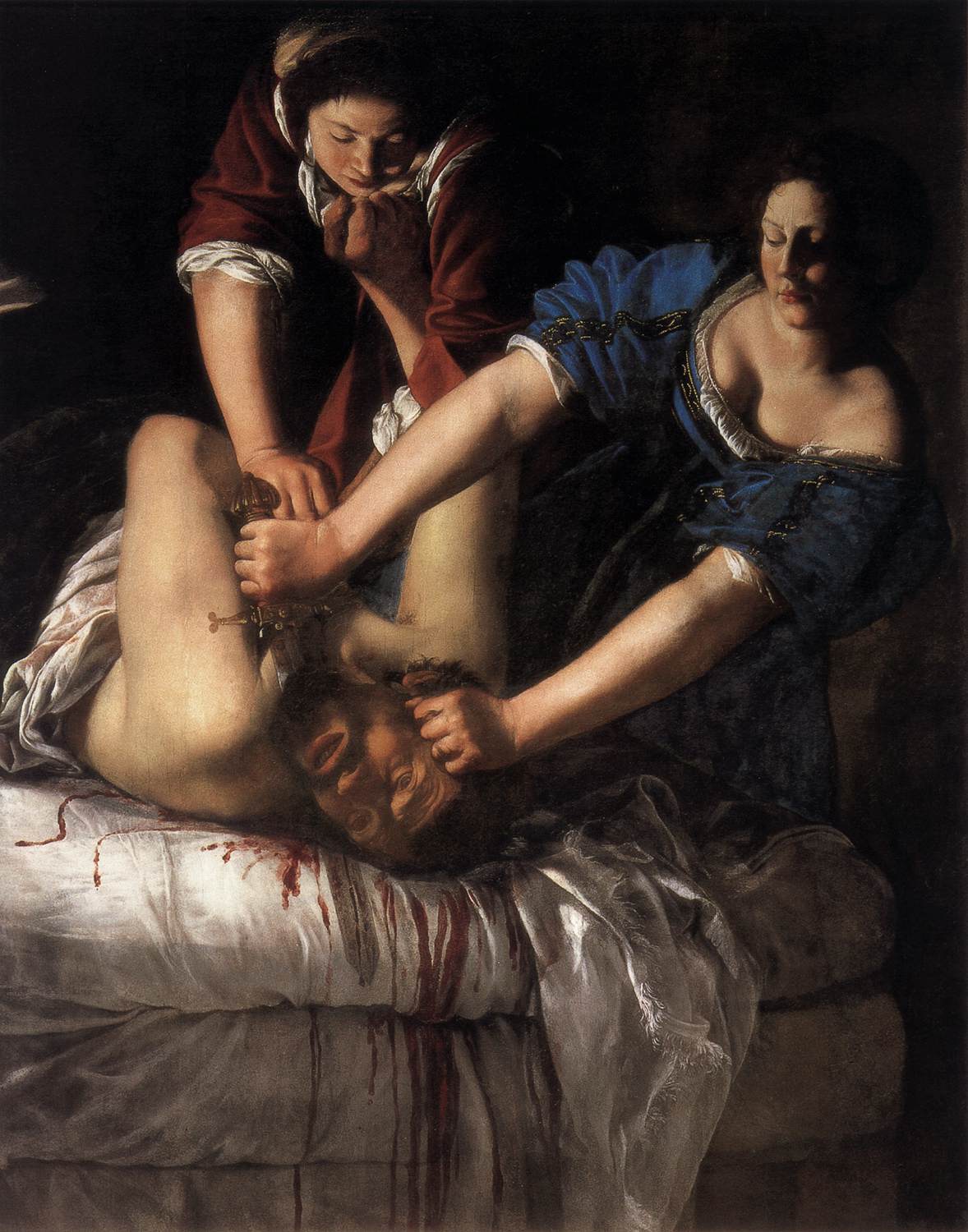
- Artemisia Gentileschi, Judith und Holofernes, um 1612–1613 Öl auf Leinwand 158,8 × 125,5 cm Museo di Capodimonte, Neapel
-
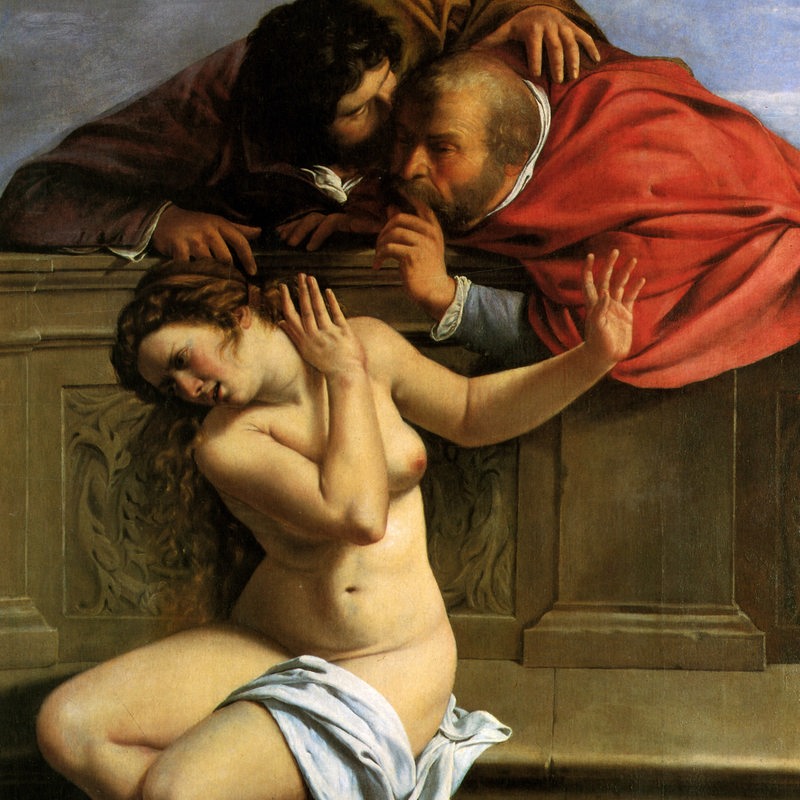
- Artemisia Gentileschi, Susanna und die Alten, entstanden 1610, Schloss Weissenstein, Pommersfelden.
Rachel Ruysch, a master of Baroque flower still lifes, stages plants in their beauty and vulnerability, with fine details of blossoms and thorns that simultaneously entice and repel. In contemporary art, Olafur Eliasson investigates the relationship between nature, perception, and experiences of boundaries, while Kara Walker symbolically plays with motifs of beauty and threat. She confronts her viewers with images that attract and at the same time repel—similar to a familiar motif that, upon closer inspection, loses its beauty and produces unease. In this sense, she exposes the seduction of seemingly harmless narratives and lays bare the underlying power structures.
Jennifer Wen Ma (born 1973 in Beijing, lives and works between New York and Beijing) uses plants as both material and metaphor. She is particularly known for works in which she covers living plants with Chinese ink—an organic, plant-based medium—thus transforming them into living sculptures and interactive landscapes. In her installation Hanging Garden in Ink (2012), around 1,500 living plants were dyed black with Chinese ink and suspended in the exhibition space. The work plays with the contrast between life and stasis: the plants continue to grow, producing green buds that emerge from the black ink, thereby making visible the resilience and endurance of life.
Plants initially become visible through their form, color, and presence and draw attention to themselves—especially as they create a kind of garden image within the space that feels natural, familiar, and sensual. Despite being slowed by the ink, the plants continue to grow and break forth anew. This visible—almost combative—growth can be read as a metaphor for the will to survive, persistence, and the resilience of life.
Anaïs Horn’s multidisciplinary practice moves fluidly across media, creating intimate, often site-specific settings. Her work traces the tension between presence and absence, where personal narratives—autobiographical fragments, rites of passage or the biographies of historical (female) figures—evolve into broader reflections on contemporary existence and how memories and (her)story/stories echo through the spectral presence of objects and spaces.
Her images take shape by exploring surfaces and objects, and they frequently unfold into spatial installations and artist‘s books.
Next to personal narratives she is introducing elements of illusion and mystery, trying to situate her work in a space of the in-between that touches upon Jean Baudrillard’s radical thinking, that draws its power—similar to the real image that makes us aware of this “trembling of the world”—from the rejection of reality. Instead of creating transparency, the secret is reintroduced: Making mysterious what is clear, incomprehensible what is comprehensible, returning the world as we got it, incomprehensible.
-
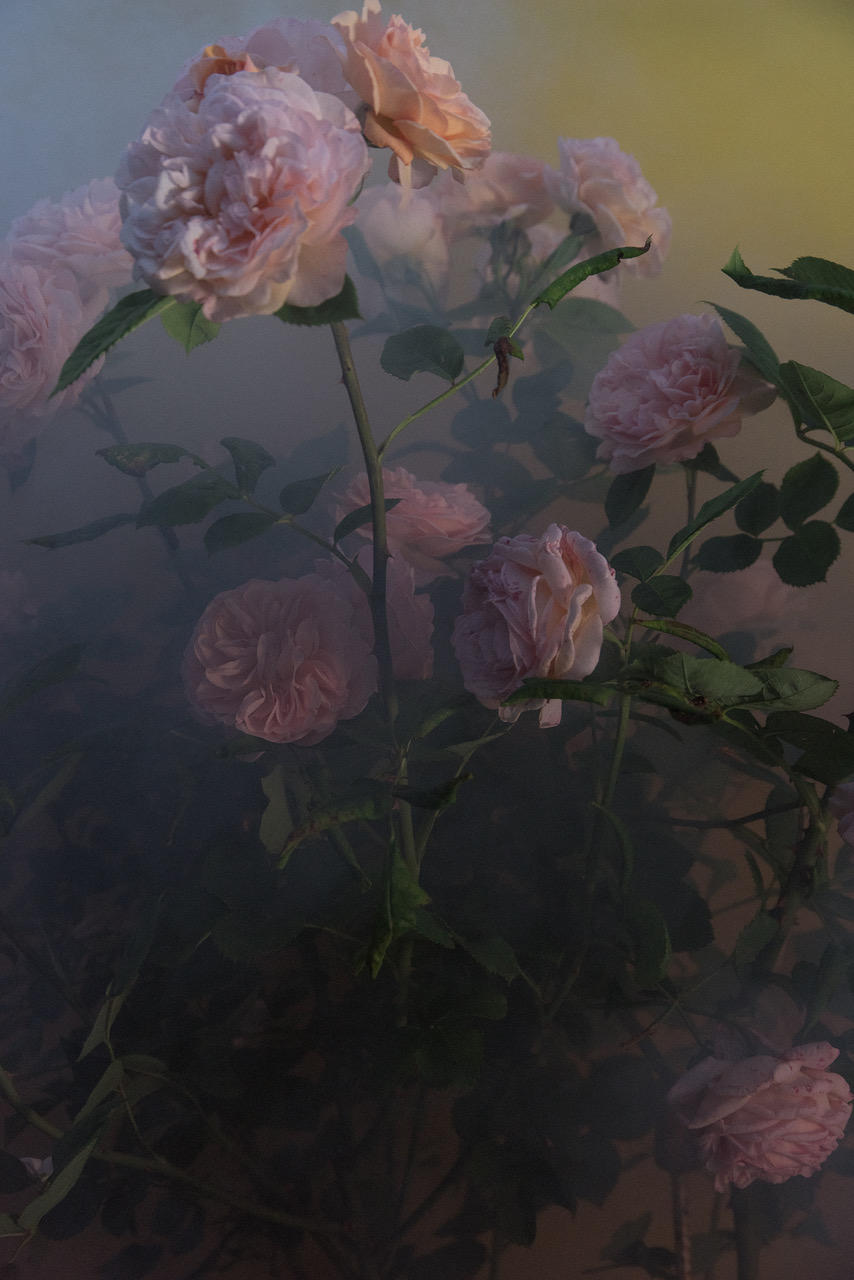
- I like listening to night creatures, Untitled (Charles Austin, 1971) (c) Anaïs Horn 2022
-
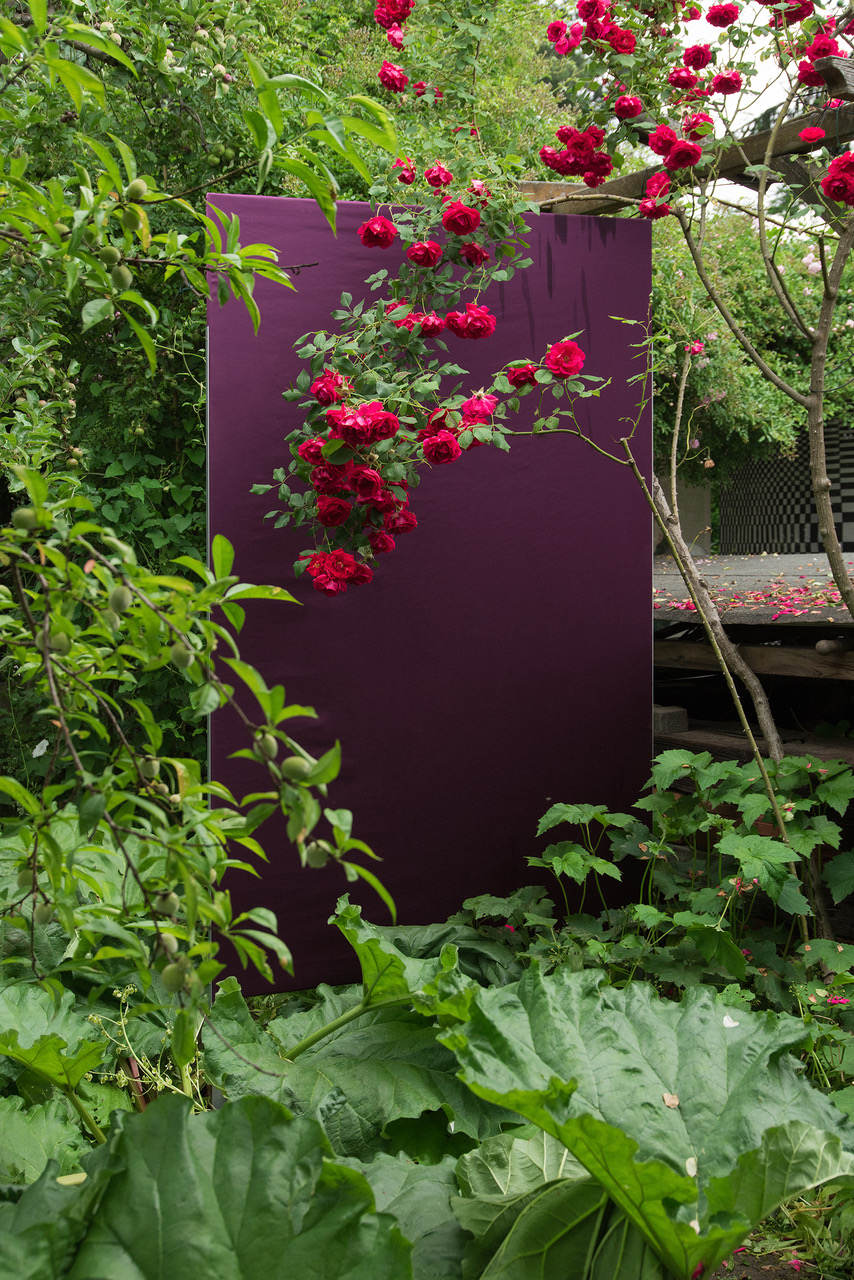
- Anaïs Horn, aus der Serie/from the series: I like listening to night creatures, Untitled (Chrysler Imperial, 1952), 2022, direct print on acrylic glass and laminated on alu-dibond, 60 × 40 cm, in artist’s frame.
-
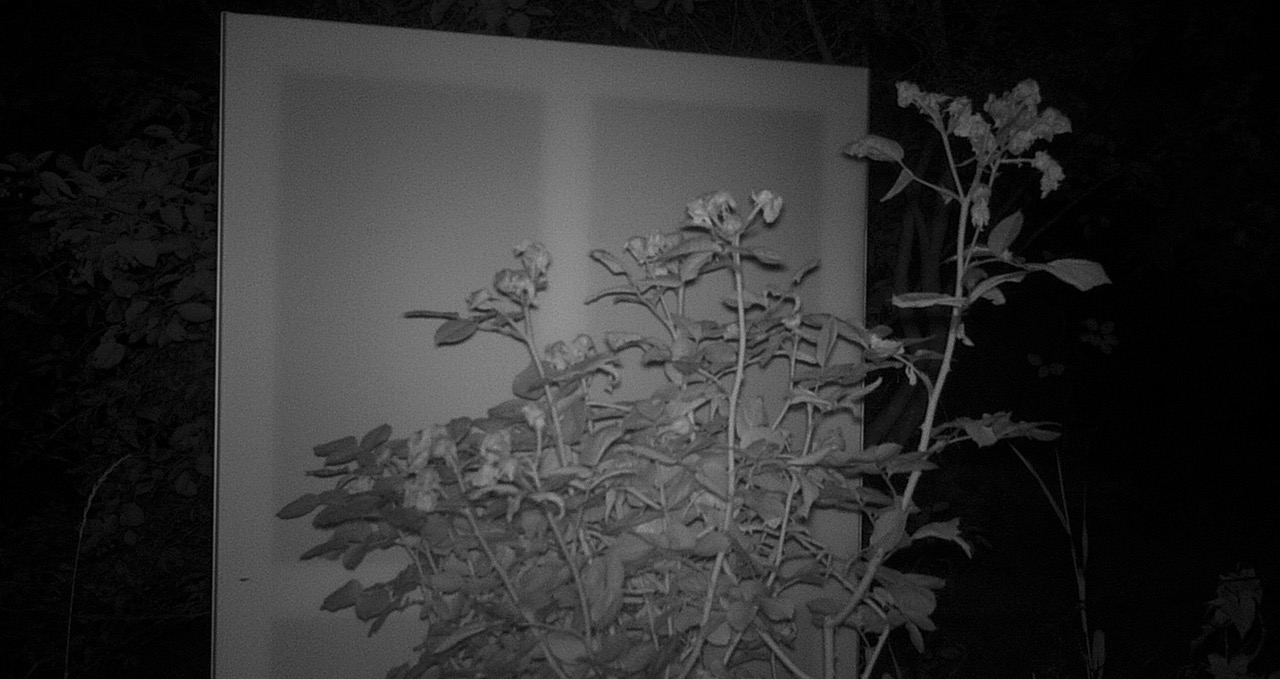
- Blooming Simulacra (c) Anaïs Horn 2022-Videostill
Anaïs Horn created the installation BLOOMING SIMULACRA in for the kunstGarten in 2022.
A glow of light on the drapery, flowers sinking into darkness, is it evening light streaming through a delicate curtain, or is it the last flicker of a candle that illuminates this image? How still are the objects in this still life, how dead is nature in this natura morte? Radical thinking (Baudrillard) draws its power – similar to the real image that makes conscious “this trembling of the world” – from the rejection of reality. Instead of creating transparency, the secret is reintroduced: Working out the illusion, creating it. Making mysterious what is clear, incomprehensible what is comprehensible: returning the world as we got it, incomprehensible. For “Blooming Simulacra” Horn stages living still lifes. A moment of emergence is depicted photographically, a moment in the course of passing, in circulation – a nocturnal illusion – made visible as it can never be visible. After this moment of appropriation, the living images are returned to nature and transformed: as witness remains the one image, the punctum. In the exhibition these pictures are presented – but also the living Still Lifes made of frames, fabrics and plants, which have then been left to the course of nature for several weeks and have changed, at every time of day and night, at every moment, will never look the same again. The secret of the individual image remains hidden forever.
Blooming Simulacra, installation, 2022, Duchesse-satin (indigo 80 × 50, purple 180 × 110, gold 130 × 80, petrol 120 × 190) on stretcher frames and aluminum stands.
We call change in a person the effect of time, 2022, video (color, sound), 2:50, sound composed and performed by Eilert Asmervik.
From the series: I like listening to night creatures, Untitled (Charles Austin, 1971), Untitled (Chrysler Imperial, 1952), Untitled (Salet, 1854), Untitled (Comte de Chambord, 1860), all 2022, direct prints on acrylic glass and laminated on alu-dibond, 60 × 40 cm each,
in artist’s frame.
The short cut We call change in a person the effect of time, 2022, video (color, sound), 2:50, sound composed and performed by Eilert Asmervik, supplemented the installation, which finally concerned the entire rose garden, where the sensual visual, auditory, olfactory and haptic component could be experienced.
The artist’s book is an important medium for her work. Je suis malheureuse et heureuse was shortlisted for the Photo-Text Book Award at the photo festival Les rencontres d’Arles 2021 and in the official selection of the Oslo Fotobokfestival.
Anaïs Horn, born in Graz (AT), lives and works in Paris (FR), and Lunigiana (IT). With a background in literature and communication design she graduated from Friedl Kubelka School for Fine Art Photography, Vienna in 2015. She has been awarded several scholarships and residencies, e.g. at the Cité Internationale des Arts, Paris (2017–2018 and 2021) or the ISCP New York City (2020–online, 2022, 2025).
In 2022, together with Boah Kim, she co-founded the publishing house Drama Books, Paris.
In 2023 she co-founded, together with her partner Eilert Asmervik, the artist-run pop-up space Cabanon in her Parisian studio.
In a broader sense, these botanical strategies also reflect human experiences. Seduction and resistance, desire and boundary, proximity and distance are not solely cultural or political phenomena—they are deeply rooted in the mechanisms of life itself.
Viewing plants thus opens up a new perspective: seduction no longer appears merely as a moral temptation, but as an elemental force of survival. Resistance, in turn, becomes a necessary condition of self-assertion. Together, the two form a balance that connects nature, art, and society.
Irmi Horn