
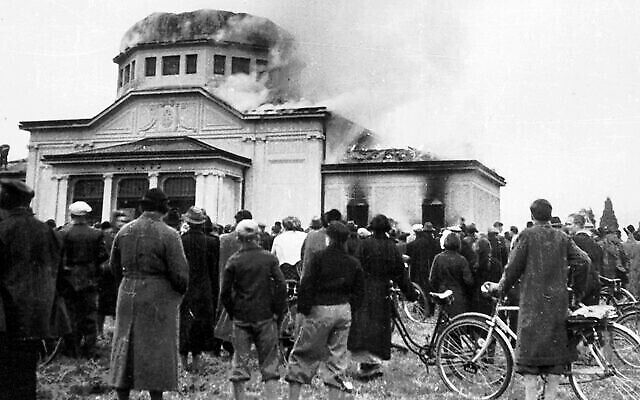
In Graz, Austria, onlookers watch a smoldering synagogue the morning after Kristallnacht, Nov. 10, 1938 (Public domain)
The November pogroms of 1938 were a sign of dehumanization. The culture of remembrance should shake us up and work against hatred and persecution.
Irmi Horn reads from SCHACHNOVELLE, The Royal Game (Chess Story) by Stefan Zweig, which he wrote in exile in Brazil in 1941 and 1942. It is his last and also his best-known work.
At the heart of the story is the confrontation between the psychological abysses within a former Gestapo prisoner and the superficial world of wealthy travellers. Initially, chess serves merely as a pastime or a lucrative sport aboard the ship. It only acquires its deeper significance through the character of Dr. B., the former prisoner, who became intensely involved with chess during his imprisonment. (Wikipedia)
Stefan Zweig (born 28 November 1881 in Vienna’s 1st District, Austria-Hungary; died 23 February 1942 in Petrópolis, Rio de Janeiro State, Brazil) was an Austrian writer, translator and pacifist.
Zweig was one of the most popular German-language writers of his time. Through his widely read psychological novellas, such as Burning Secret (1911), Fear, Letter from an Unknown Woman and The Royal Game, as well as his literary biographies, including Magellan: The Man and His Deed and The Right to Heresy: Castellio Against Calvin, he became one of the leading German-language storytellers of the early 20th century.
His writing is characterised by vivid imagery and a pleasing musical quality. In terms of narrative style and literary technique, his works largely adhere to the principles of realism. They combine classical elements, including dramatic plot structures, with psychologically nuanced characters, often portrayed from different perspectives. In this way, Zweig offered his broad readership access to literature that reflected the realities of their time without confronting them with modernist narrative techniques.
Among his numerous prose works, particularly noteworthy are The Royal Game (Chess Story), The Tide of Fortune (The Star Hours of Humanity) and his memoir The World of Yesterday.
Faced with a world that had become “cruel and insane”, Stefan and Lotte Zweig decided to end their lives. During their final days, they wrote farewell letters before taking their own lives on the night of 22–23 February 1942 with an overdose of the sleeping medication Veronal.
The death certificate records the time of death as 12:30 p.m. on 23 February 1942 and gives the cause of death as “ingestion of poison – suicide”. Their domestic staff found them both in their bed at around 4 p.m.: Stefan lying on his back with his hands folded, and Lotte leaning against him on her side.
In his farewell letter, Zweig wrote that he would leave this life “of my own free will and with a clear mind”. The destruction of his “spiritual homeland, Europe”, had left him feeling uprooted, and his strength, he wrote, had been “exhausted by the long years of wandering without a home”.
INFORMATION
- Please make reservations not later than 2 hours before the programme begins: kunstGarten@mur.at or +43 316 262787
- Price