
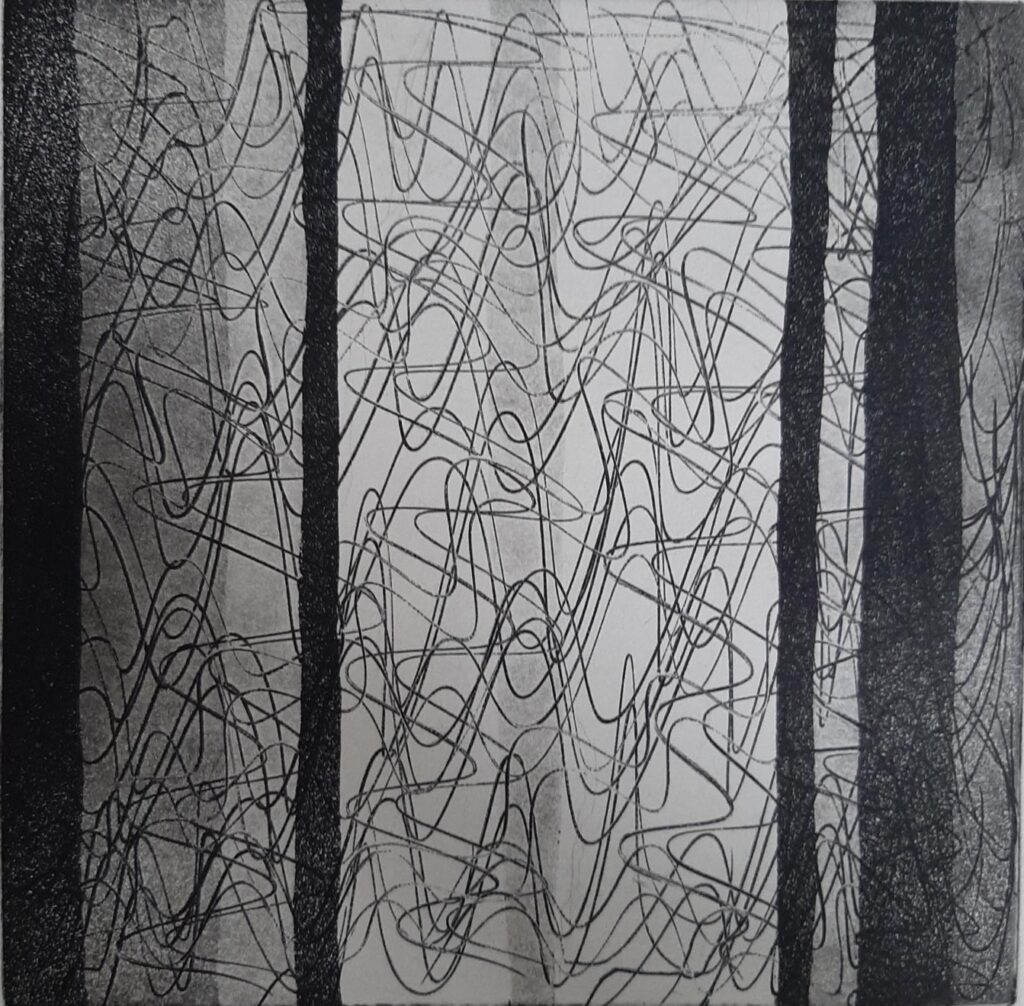
Barbara Hammer, About Alma Karlin, Radierung, 2026 - Ausschnitt/Detail
On 15 March, the entry of traditional printing techniques in the Federal Register of Intangible Cultural Heritage of the German UNESCO Commission will be celebrated as Printmaking Day.

On 15. In March, the entry of traditional printing techniques in the National Directory of Intangible Cultural Heritage of the German Commission for UNESCO will be celebrated as the Day of Printing.
kunstGarten is participating with an exhibition featuring works by Barbara Hammer (Austria), women artists from the Austrian-Slovenian Friendship Association Graz (Društvo Avstrijsko-slovensko prijateljstvo Gradec), an interview conducted by Prof. Dr. Kasilda Bedenk with the Slovenian writer Jerneja Jezernik, and a reading by Irmi Horn. Duration: 15th of March to 2nd of May.
In her works, Barbara Hammer engages with the life of Alma Karlin and her remarkable life story, placing it within two artistic contexts: Fiji and Slovenia.
FIJI
In 2008, personal circumstances brought Barbara Hammer to Fiji.
Almost one hundred years earlier, Alma Karlin had travelled through the South Pacific and experienced Fiji at the beginning of the 20th century.
The transformed living environments that have since emerged in Fiji are translated by Barbara Hammer into minimalist woodcuts. These works comment on the present day while opening up new modes of perception through the medium of printmaking.
SLOVENIA
The etchings created in 2025/26 serve as a means of approaching Alma Karlin’s life during the years 1943/44.
They embody Alma’s confrontation with the realities of that period during the Second World War, her striving for independence, freedom, and a self-determined life.
The different colour variations of the prints represent experiences that Alma Karlin describes from her time with the Partisans.
Red refers to her beloved coat, which was characteristic of her appearance.
Green relates to the forest and the beauty of the Slovenian landscape.
Black symbolizes pain, grief, and death.
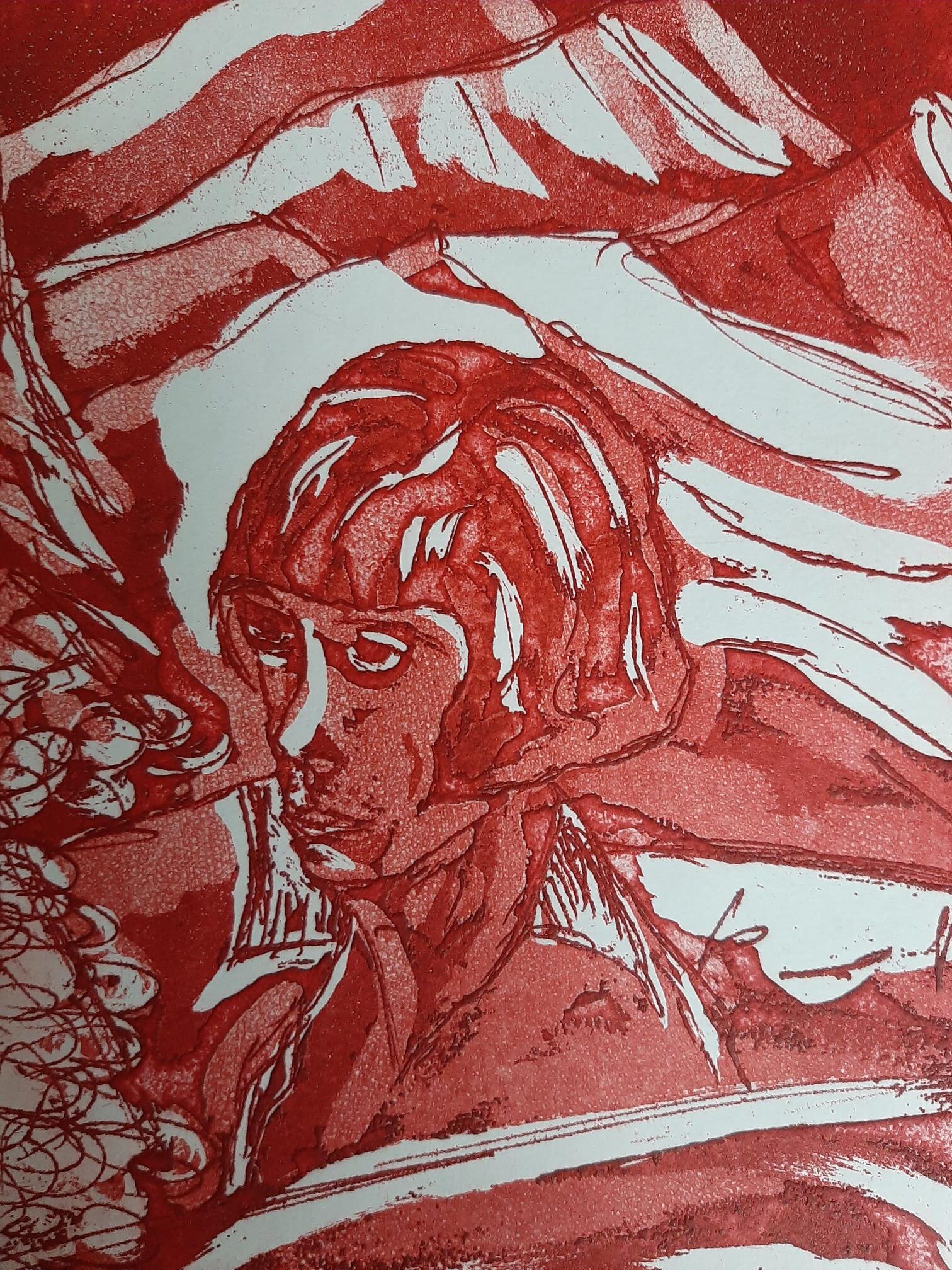
Barbara Hammer, Alma Karlin, Radierung ,2026
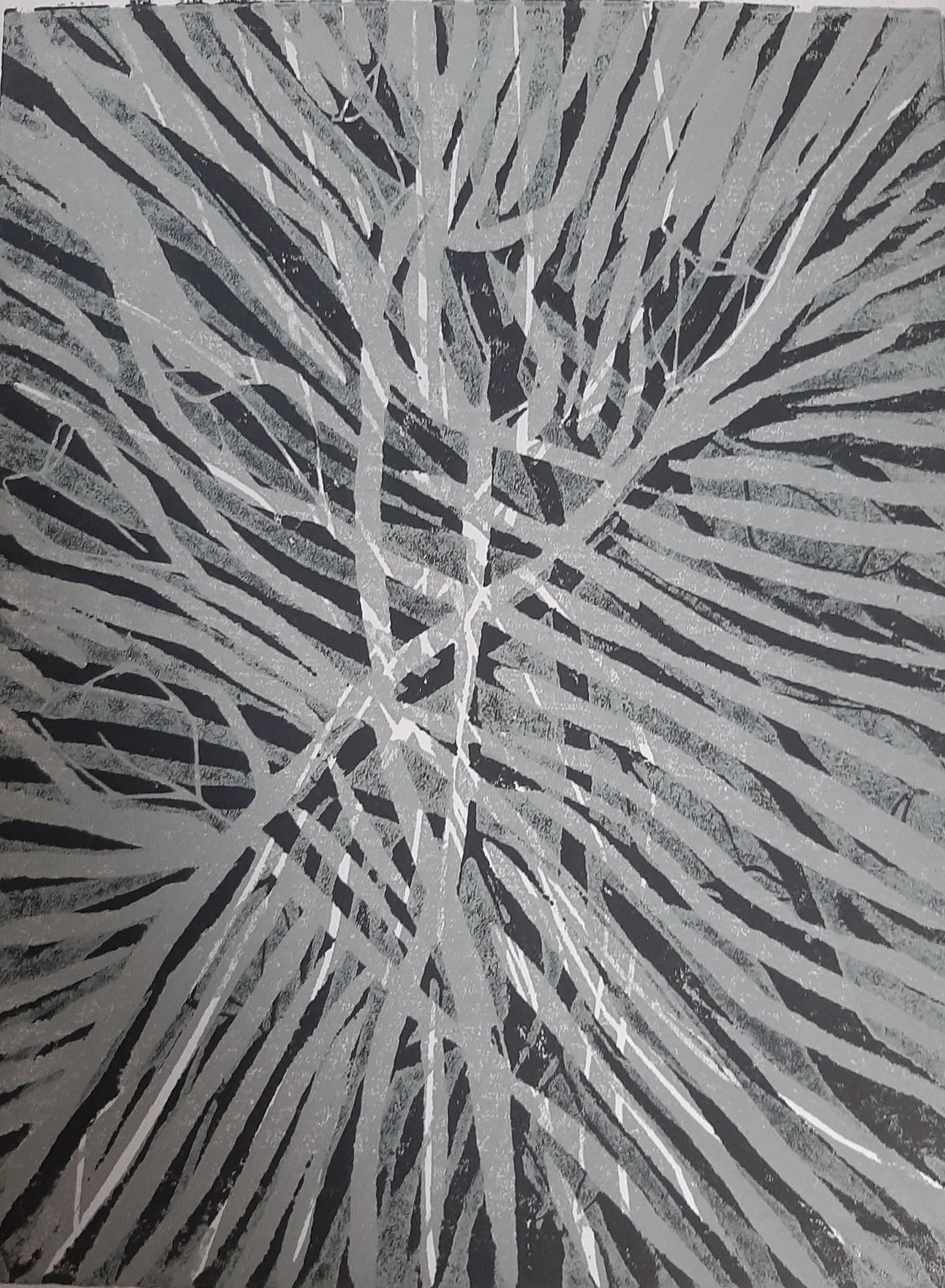
Barbara Hammer, About Alma Karlin, Holzschnitt/Woodcut, 2006 – 2026
Barbara Hammer was born in Graz, where she still lives and works as an artist today.
Since 1986, she has been deeply engaged with painting and printmaking, continuously pursuing further artistic education through summer academies in Berlin and Dresden, as well as at the Printmaking Workshop of the Dresden Technical Collections (Technische Sammlungen Dresden).
In her artistic practice, Barbara Hammer is particularly concerned with contemporary social and political issues. She takes a clear stance against injustice and threats to human dignity. The shortcomings in the protection and implementation of human rights currently form the central focus of her work. Her most recent etchings are contemporary socio-political statements that reflect these concerns.
Barbara Hammer has presented her work in numerous exhibitions in Austria and abroad.
She is a member of the Professional Association of Visual Artists of Austria (Berufsvereinigung der Bildenden Künstler Österreichs) and of XYLON International, the International Association of Wood Engravers and Woodcut Artists, Austrian Section.
Alma Maximiliane Karlin (* 12. October 1889 in Cilli, Austria-Hungary, today Slovenia; † 14. January 1950 in Pečovje, municipality of Štore near Celje, Slovenia) was a journalist and the most widely read German-language travel writer between the world wars. She became best known for her multi-year world travel, which was undertaken shortly after the First World War, and the books published about it.
Alma Karlin, an extraordinary woman—a “female being,” as she called herself—writer, world traveler, researcher, polyglot, theosophist, and citizen of the world, is an eminent figure from Celje whose memory remains indelibly embedded in the consciousness of the city and its inhabitants. In Slovenian cultural memory, however, knowledge of her and awareness of her literary, scholarly, and spiritual legacy have often first encountered the national reproach: “But she was German, because she wrote in the German language.” The period in which she grew up and matured into an independent personality was marked by the decline and dissolution of the Austro-Hungarian Empire, and for Karlin, national affiliation mattered far less than the individuality of the human being.
“Since only German was spoken in our home, and my mother worked for almost forty years as a teacher at the German school, I too received a German upbringing and maintained close contact with German-speaking people. Even in the home of my Slovenian aunt, German was spoken to me. Therefore, one cannot reproach me for belonging to the German people, nor for the natural fact that I dedicated the results of my research and my literary achievements primarily to that people. A person is the product of their upbringing.”
Born with a physical disability and asymmetrical eyes, she was predicted either a short life or, alternatively, intellectual impairment. Although her frail constitution remained with her throughout her life, she developed at an early age an exceptionally strong sense of self and a clear vision of her goals: to understand the languages of the world, to travel around the globe, and to become a writer of international stature. Her remarkable linguistic talent, already evident during her informal education at home in Celje, reached its full flowering during her stay in London between 1908 and 1914, where she passed examinations in eight languages at the Royal Society of Arts. London, with its Babylonian mixture of races, cultures, and languages, strengthened her determination to travel the world and to report on the knowledge, discoveries, and experiences she encountered along the way.
The result was an eight-year journey around the globe, during which she visited every continent and stayed in some of the most remote corners of human civilization. With tireless enthusiasm, she continuously wrote and sketched throughout her travels. After returning home, she published her famous three-part travel account—The Lonely Journey Around the World, The World as Experienced, and Under the Spell of the South Seas. These works went through multiple editions, achieved a combined circulation of more than 100,000 copies, and were translated into English, Finnish, and eventually Slovenian. They were followed by numerous additional books through which Karlin achieved fame across Europe, if not worldwide. In the German-speaking world of the 1930s, she became so popular that Alma Karlin societies were established in Germany, Switzerland, and Austria, bringing together admirers of her writings and worldview. The Swedish Nobel Prize-winning author Selma Lagerlöf even informally proposed her as a candidate for the Nobel Prize. In Slovenia, however, her works initially received little recognition until Slovenian ethnologists “rediscovered” her in the 1960s.
During the era of Nazi rule—a regime that Karlin opposed with her entire being—she prohibited the publication of her books within the Reich. Because she sheltered and assisted dissidents fleeing Nazi persecution, she herself was destined for Dachau. Pressure exerted by influential Germans within the Reich, together with the efforts of her “soul sister,” Thea Schreiber Gamelin, ultimately saved her from almost certain death in the concentration camp.
Karlin was misunderstood by the vast majority of her contemporaries. They failed to recognize in her a highly developed personality and instead saw only an eccentric woman who had not found her place within conventional gender roles. Her gift of foresight, her understanding of universal principles, and the penetrating clarity of her thought were interpreted as witchcraft.
Because the people could not recognize her as one of their own, she gradually fell into oblivion.