
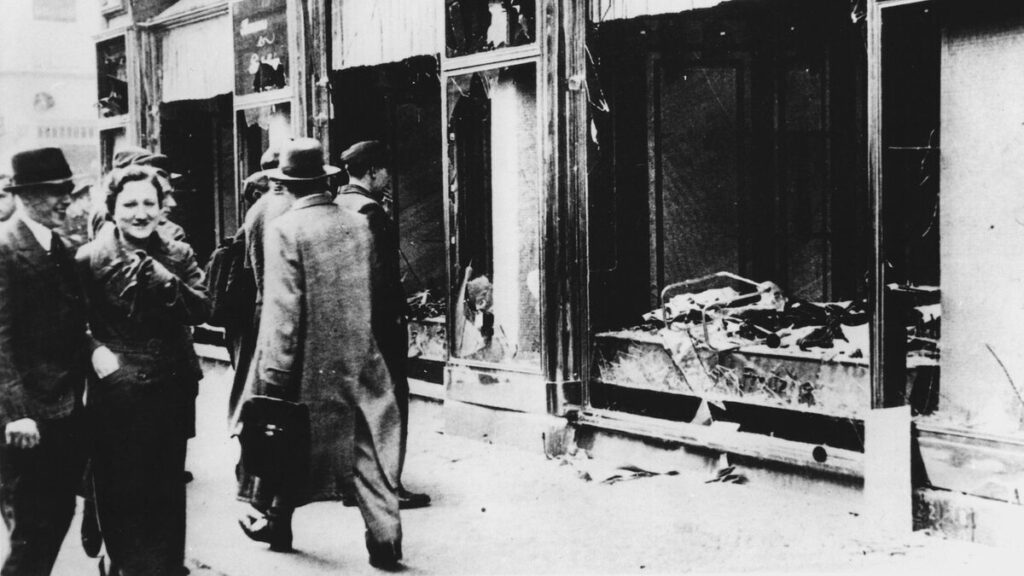
Gewaltexzesse gegen Jüdinnen und Juden in der „Reichskristallnacht“ am 9. November 1938 Foto: wikimediacommon
The November pogroms of 1938 were a sign of dehumanization. The culture of remembrance should shake us up and work against hatred and persecution.
Irmi Horn reads from Deborah Eisenberg “”Rosie besorgt sich eine Seele. Wahrscheinliche Geschichten”, Rowohlt Buchverlag, 24. März 2000 (Original: “All Around Atlantis”)
A woman processes an entire unlived life including the Holocaust in a letter written too late.

Deborah Eisenberg © Hartwig Klappert
Deborah Eisenberg, born in Chicago in 1945, studied Latin, Greek and anthropology. She lives with her partner, the playwright and actor Wallace Shawn, in New York.
We are what happened to our grandparents. The short story is a high-line act of literature, and Deborah Eisenberg is a master of this genre.
Source: https://literaturfestival.com/authors/deborah-eisenberg/
Deborah Eisenberg was born in Chicago in 1945 and grew up in the suburb of Winnetka. In 1966, she moved to New York and studied social science at the New School for Social Research. She then worked in various jobs, including a waitress and secretary. After meeting her life partner, the playwright and actor Wallace Shawn, she began writing. She debuted with the stage play »Pastorale« (1982), which was performed by the theater group Second Stage. In the mid-1980s, she published her first short story »Flotsam« in the »New Yorker«, which published her volume »Transactions in a Foreign Currency« (1986; dt. »Traveling with light luggage«, 1989).
To date, Eisenberg has published four volumes of short stories that elevated her to the rank of a master of her trade and an important chronicler of modern American city life. Mostly through dialogues and precise, pointed descriptions, it evokes interior views of American characters who paralyze themselves by excessive expectations. With a fine sense for phrases, clichés and false self-images, she shows mechanisms of self-deception and flight from reality, but also the arduous resistance against it. However, any comprehensive knowledge or decisive insight remains denied to the characters. The cover story of her volume »Under the 82nd Airborne« (1992; dt. »Eine ehhrreiche Geschichte«, 1991) tells, for example, of a woman whose dream of a career as an actress is becoming increasingly unrealistic. After not taking care of her daughter, who now lives in Honduras, for seventeen years, she arranges a meeting with her. However, there is no real rapprochement between the two.
The German translation of Eisenberg’s latest collection of stories »Twilight of the Superheroes« (2006; Ü: Superhelden-Dämmerung) is currently being prepared. The work draws its tension from the different attitudes of the ages: cynicism and hope, enlightenment and naivety. “I think there are many moral arguments for stories,” Eisenberg summarizes the claim of her own works. »They meet in the fact that storytelling is one of the most effective methods of depicting elusive states of mind and human experiences.«
Eisenberg’s short stories appeared in publications such as »The New Yorker«, »Bomb«, »The Yale Review« and »Kursbuch« (2006). She received several scholarships, including the Lannan Foundation Fellowship, and received awards such as the Whiting Writers’ Award, the Award for Literature of the American Academy of Arts and Letters, five O. Henry Awards, and the Rea Award for the Short Story. Eisenberg works as a professor of creative writing at the University of Virginia and lives in New York.

INFORMATION
- Please make reservations not later than 2 hours before the programme begins: kunstGarten@mur.at or +43 316 262787
- Price