
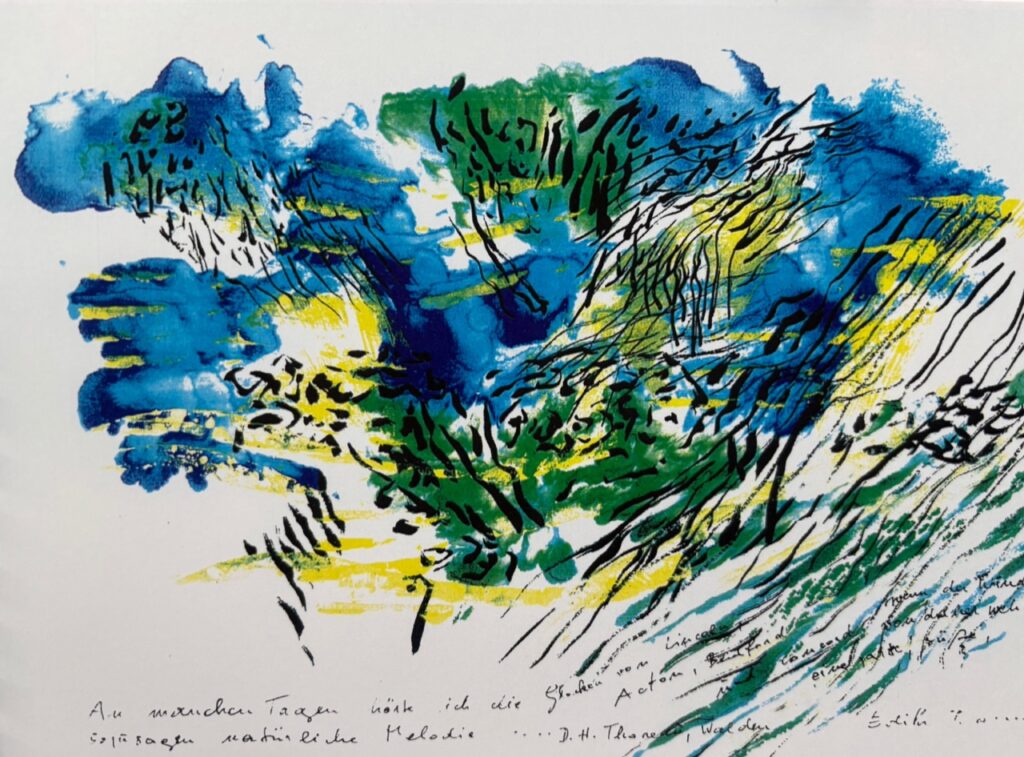
Edith Temmel WALDEN, 2024, Monotypie in Farbe
Printmaking Day is an annual event celebrating the art of printmaking after traditional printing techniques were added to the German UNESCO list of intangible cultural heritage on March 15, 2018.

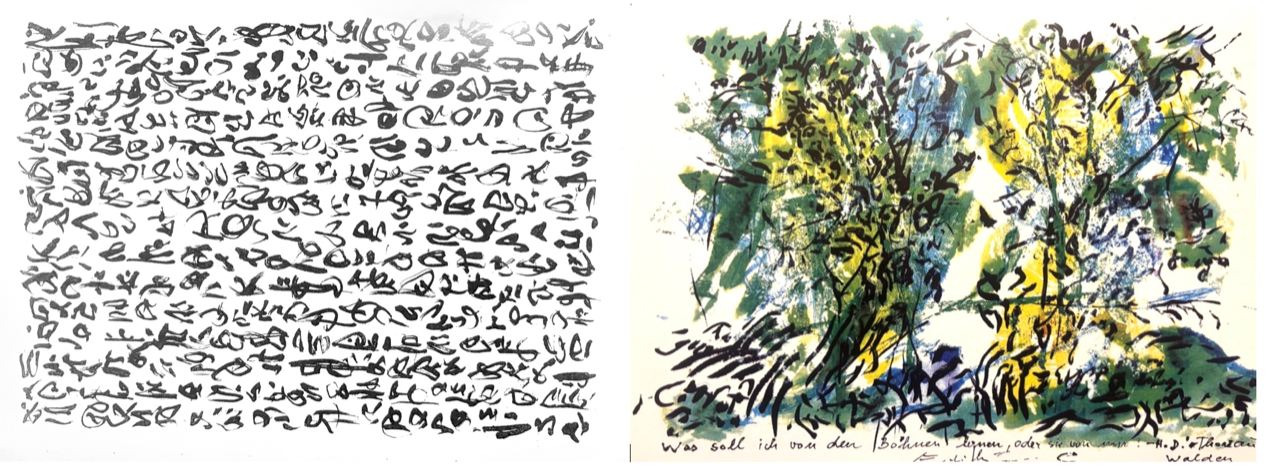
Edith Temmel WALDEN,
Graphik 2015, Print 2025
kunstGarten is celebrating with an exhibition by Edith Temmel – WALDEN, which can be seen until May 11, 2026. Curated by Irmi Horn.
Opening speaker: GR.in DI.in Daniela Schlüsselberger and art historian Dr.in Tanja Gurke
Henry David Thoreau’s Walden holds a firm place among the most influential books in American literary history. In pre-Marxist times, it could be found in many working-class households; in the 20th century, it inspired the conservation movement as well as the protest movements of 1968. It has also enjoyed widespread recognition outside the United States: for example, Mahatma Gandhi explicitly referenced Walden with his ideal of nonviolent resistance and his ascetic lifestyle. With the title of his utopian novel Walden Two, B.F. Skinner references Thoreau’s ideals, which in turn inspired further ideas from Rubén Ardila (Walden Tres) and Rolf Todesco (Walden III).
A quote from the last chapter of the book gained particular notoriety: “If a man does not keep pace with his companions, perhaps it is because he hears a different drummer. Let him step to the music which he hears, however measured or far away. It is not important that he should mature as soon as an apple-tree or an oak. Shall he turn his spring into summer?”
From Wikipedia
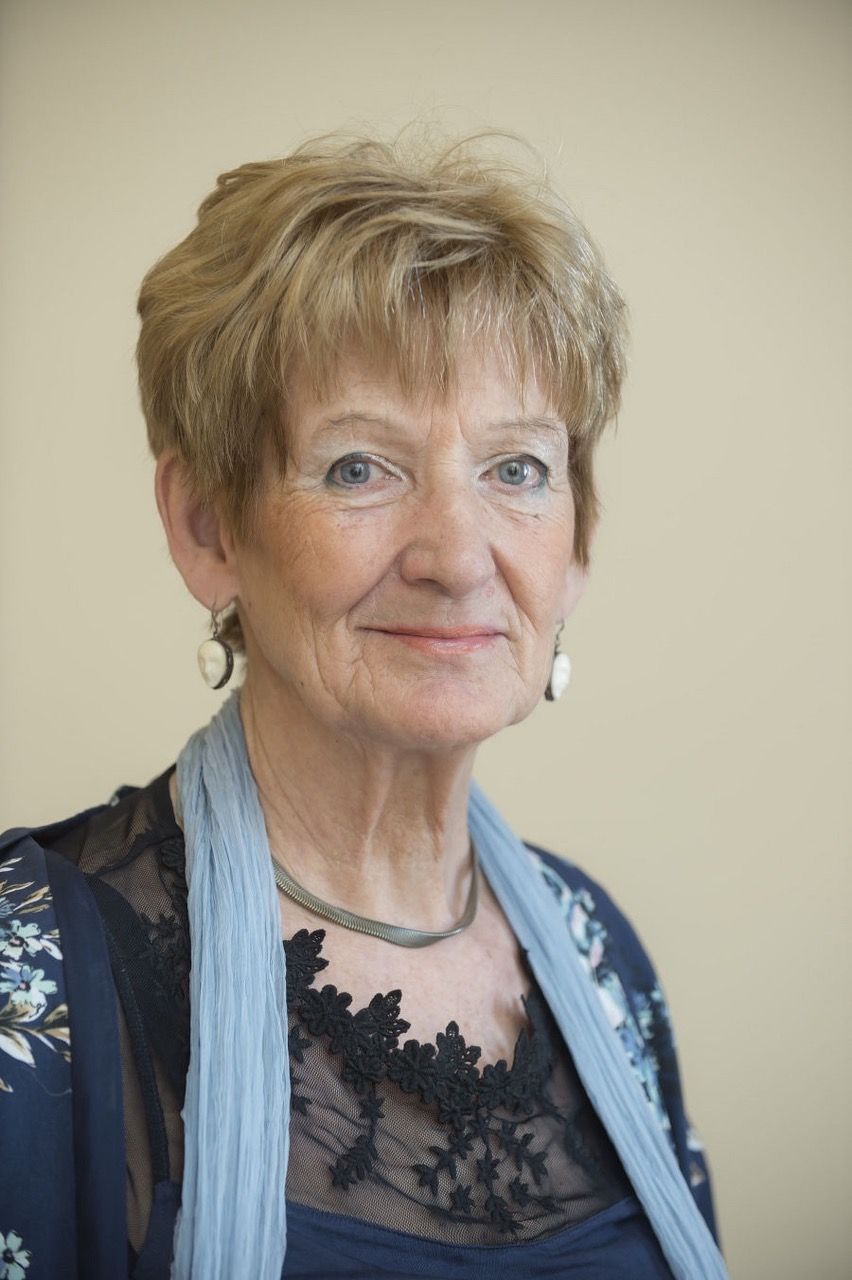
Edith Temmel (c) Stadt Graz, Bürgerin der Stadt
Walden has established itself as one of the most influential works of American literature. As early as the nineteenth century, it was widely received and—well before the spread of Marxist theories—found its way into many working-class households. In the twentieth century, Thoreau’s plea for a simple, self-determined life became a source of inspiration for various social movements: it influenced the emerging conservation movement as well as the protest and alternative cultures of the 1960s.
Internationally, too, the book had a lasting impact. Mahatma Gandhi explicitly referred to Thoreau’s ideas, particularly the ideal of nonviolent resistance and a consciously simple, ascetic way of life. The psychologist Burrhus Frederic Skinneralluded to it in the very title of his novel Walden Two, in which he outlined the model of a communally organized utopia. Later works such as Walden Tres by Rubén Ardila or Walden III by Rolf Todesco primarily draw on Skinner’s social vision and develop the idea in their own distinct ways.
In the face of the current climate crisis and the ongoing destruction of habitats through wars driven by patriarchal claims to power, the thought of Henry David Thoreau gains renewed relevance. His radical reduction to the essential, his critical view of consumption, growth, and belief in progress, as well as his respectful relationship with nature, point to questions that appear more urgent than ever in the context of climate change.
A particularly well-known idea appears in the book’s concluding chapter. Thoreau encourages readers not to submit to the uniform march of the majority: if someone does not keep step with others, perhaps it is because they hear a different drummer. Each person, he suggests, should be allowed to follow the “music” they hear themselves—no matter how unfamiliar its rhythm may seem. In times of global ecological challenges, this appeal can be understood as an invitation to venture new paths: toward a different understanding of prosperity, toward more sustainable action, and toward a form of progress that does not come at the expense of future generations.
The Graz-born artist Edith Temmel (born August 23, 1942), who still lives there today, has worked for decades as an independent painter. She only began painting intensively at the age of twenty-five; in her early years she was influenced by the Styrian painter Elga Maly. She also received decisive impulses during painting retreats with Josef Fink at the Minoriten Cultural Center in Graz, where she encountered international artists and deepened her understanding of painting.
In her early creative phase, Temmel devoted herself primarily to biblical themes. She produced extensive cycles on the Old Testament, as well as large-format stained-glass windows and church commissions. Her works have been presented in numerous exhibitions at home and abroad, including in Vienna, Darmstadt, Osnabrück, Tel Aviv, Marburg, and Brussels.
A significant turning point in her work occurred more than fifty years ago, when she realized that she perceives colors while listening to music—a phenomenon known as synesthesia. What may be unsettling for some became a creative source for Temmel. Since then, her paintings have often emerged in direct response to music: to Vivaldi, Bach, or Chopin, as well as to jazz. Her painting is not an illustration, but a simultaneous translation of sound into color, rhythm into movement, and musical structure into pictorial composition.
In 1996, she learned the art of fusing (glass fusion).
Edith Temmel is the initiator and founding member of the styrianARTfoundation, established in 2005. Each year, Styrian artists’ retreats are held at Rein Abbey. It is very important to her to strengthen the regional art scene. Cooperation, not competition, is to be encouraged. In 2014, the tenth edition of the creative meeting took place at Rein Abbey. A particular concern within this association is the promotion of young Styrian artists.
For Auxiliary Bishop Franz Lackner, she designed an elaborate chasuble in silk painting technique on the occasion of his appointment as Bishop of Salzburg. It depicts a flock of blue birds on a green ground, representing the Sermon to the Birds of Saint Francis of Assisi. She also designed liturgical vestments for John Paul II and Pope Benedict XVI.
In her artistic engagement with Walden, Edith Temmel combines this synesthetic working method—the voices of the forest—with the spiritual dimension of Thoreau’s text. Just as Thoreau invokes the “different drummer,” Temmel follows an inner sound. In her paintings, nature is not depicted naturalistically, but experienced as vibration, as an energetic field of colors, rhythms, and script-like signs. She translates the stillness of Walden Pond, the interplay of the seasons, and the concentration on the essential into multilayered color spaces that oscillate between transparency and density.
With Walden, Edith Temmel does not merely illustrate a literary work, but develops a painterly reflection on harmony — between human and nature, perception and world, sound and colour. Her works offer a sensorial approach to Thoreau’s ideas, translating them into a visual language that brings together inner perception and ecological sensitivity.
Edith Temmel WALDEN – Translation in Pictures is available for purchase in booklet form.
Henry David Thoreau (born David Henry Thoreau; July 12, 1817 – May 6, 1862) was an American naturalist, essayist, poet, and philosopher. A leading transcendentalist, he is best known for his book Walden, a reflection upon simple living in natural surroundings, and his essay “Civil Disobedience” (originally published as “Resistance to Civil Government”), an argument in favor of citizen disobedience against an unjust state.